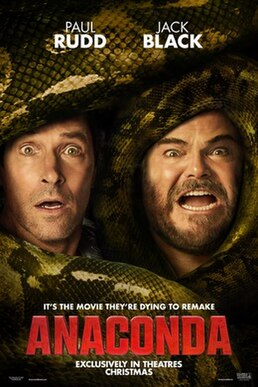
There was always something deliciously pulpy about Anaconda — a B-movie survival thriller that knew exactly what it was. The 2025 revival doesn’t just revisit the jungle; it winks at it, laughs with it, and occasionally tightens its own coils trying to be clever and crushingly tense at the same time.
“This Anaconda doesn’t just hunt its prey — it mocks the genre while coiling around it.”
What It’s About (Spoiler-Free)
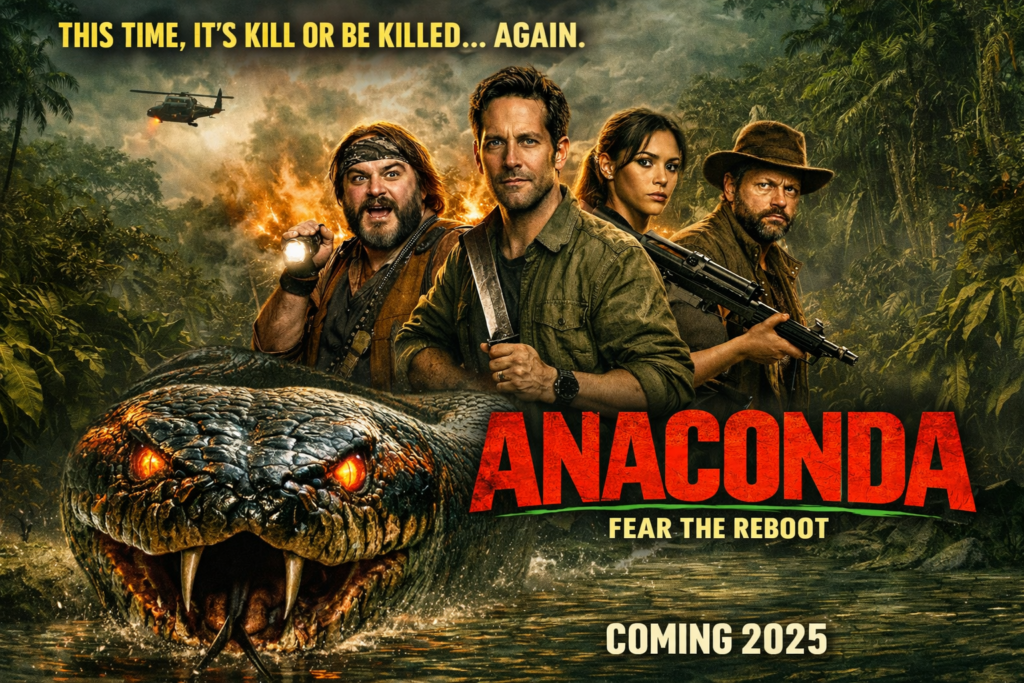
A group of modern-day creatives head into the jungle to recreate — and cash in on — a legendary creature feature from the past. What begins as a knowingly ironic expedition soon slides into real peril when the jungle turns hostile and the line between performance and survival starts to blur.
The film balances self-awareness with creature-feature suspense, frequently stepping back to comment on monster movies and Hollywood’s nostalgia addiction — even as it tries to deliver the primal thrills that made the premise endure.
Performances
The cast is the film’s strongest asset, largely because the ensemble commits to the tone: heightened, playful, and occasionally deadly serious when the snake finally makes its presence felt.
- Jack Black brings controlled chaos — broad comedic energy, but with enough commitment to keep the film from collapsing into pure parody.
- Paul Rudd plays the stabilising centre: wry, human, and oddly believable as the “we’re in trouble” anchor when things go sideways.
- Daniela Melchior adds sincerity and grit, giving the movie an emotional baseline when the humour threatens to overtake the danger.
- Selton Mello injects texture and unpredictability, echoing the off-kilter human volatility that classic jungle thrillers often use as fuel.
The Snake
The anaconda itself is handled with welcome restraint. Rather than constant full-body CGI showcasing, the film often favours partial reveals — coils in murky water, shifting shadows, the sudden snap of movement — which helps preserve scale and menace.
When the creature finally takes centre stage, the film briefly drops the wink-wink posture and becomes a straight survival thriller, delivering some of its best tension in those moments.
Direction, Tone & Craft
The film’s approach is knowingly modern: it tries to be both an homage and a commentary. At its best, that creates a fun friction — satire rubbing against suspense. At its worst, the humour undercuts the fear right as the film needs to tighten the screws.
Visually, the jungle is photographed as a beautiful trap: lush greens, humid haze, wide river expanses that quickly become claustrophobic when the action compresses into close quarters.
Where It Stumbles
- The meta-humour occasionally over-explains itself, trusting the audience a bit too little.
- The midsection sags when commentary overtakes momentum.
- Viewers wanting a straight-faced horror remake may bounce off the self-awareness.
Still, these are coils rather than fatal bites — and the film recovers whenever it lets the jungle and creature-work do the talking.
What It’s Really About
Beneath the scales, Anaconda (2025) plays with a familiar modern anxiety: the industry’s addiction to nostalgia, the blurred line between irony and sincerity, and the arrogance of thinking we control nature — or stories — once we step into the wild.
Verdict Summary
Overall Score: 7.5 / 10
| Performances | 8 / 10 |
| Direction | 7.5 / 10 |
| Score | 6.5 / 10 |
| Cinematography | 7 / 10 |
| Overall | 7.5 / 10 |
Final Word: A knowing, toothy revival — funny, dangerous, and just self-aware enough to survive. When it stops explaining the joke and lets the jungle breathe, it tightens into real entertainment.