
Directed by Ronan Day-Lewis and scored by Bobby Krlic, Anemone is a slow-burn masterwork about memory, masculinity and atonement — anchored by Daniel Day-Lewis’s devastating return to the screen after seven years away.
Cinematic Opening
The camera drifts across a grey North-Sea horizon. Wind rakes through coarse grass; the sky is a bruise of slate and salt. A solitary figure — Ray Stoker (Daniel Day-Lewis) — walks the shingle line with the hesitance of a man counting ghosts. No dialogue. Only Bobby Krlic’s low-tide drone vibrating beneath the sound of surf and breath. Anemone begins not with story, but with texture — a sensory immersion into guilt, isolation, and the faint shimmer of grace.
“Day-Lewis delivers a masterclass in silence and sorrow — a performance so inward it feels excavated rather than acted.”
The Long-Awaited Return
After declaring his retirement in 2017, Daniel Day-Lewis was the rare artist whose absence became part of his legend. Now, in Anemone, he re-enters the frame under the direction of his son, Ronan Day-Lewis — and the result is more than a comeback; it’s a conversation between generations about the weight of art and inheritance. Where his father once forged steel characters out of fire (There Will Be Blood, Gangs of New York), Ronan works with air and silence, chiselling emotion out of absence.
The film’s premise is spare: Ray, a former infantryman turned shipyard labourer, lives alone on the Yorkshire coast. His days are rituals of repair — fixing nets, patching boats, mending what cannot be mended within. When news arrives of his brother Jem (Sean Bean), gravely ill, the past floods back like a rising tide. What follows is not redemption so much as reckoning.
Direction — Ronan Day-Lewis’s Measured Grace
Ronan Day-Lewis directs with a confidence that feels born of watching greatness up close yet refusing to imitate it. His camera, guided by cinematographer Ben Fordesman, rarely moves without purpose. Each composition is balanced between stillness and tension: a teacup quivers on a table; fog rolls across a harbour like remorse. He lets the story breathe through negative space, trusting the viewer to lean in rather than be dragged.
Critics have compared his approach to Lynne Ramsay and Andrea Arnold — that British strain of lyric realism where the ordinary becomes mythic. But Ronan’s voice is his own: gentler, more philosophical. Where Ramsay builds from rage, Day-Lewis builds from grace. He shows the discipline of a director who understands the music of quiet and the power of a face in contemplation.
Performances — An Acting Trinity of Rare Power
Daniel Day-Lewis inhabits Ray like a man inhabiting penance. He barely speaks for the first twenty minutes, yet the screen thrums with unspoken grief. His hands — weather-beaten, scarred — tell a whole biography. When he finally utters a line, it lands with the weight of a confession. It is a mesmerising exercise in control, recalling his turn in Phantom Thread but stripped of ornament.
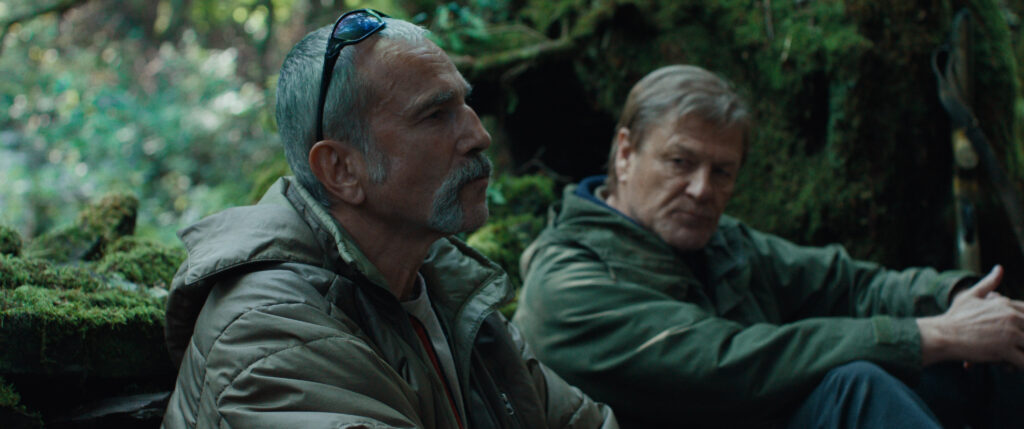
Sean Bean, as Jem, is earth to Day-Lewis’s air — a rough-hewn presence that anchors the film’s emotional reality. He plays the brother not as a foil but a mirror: a man whose sins are louder but less enduring. Their shared scenes — especially a quiet kitchen exchange where neither can say “I’m sorry” — are some of the finest acting you’ll see this year.
Samantha Morton completes the trinity as Nessa, Ray’s estranged wife. She brings fierce clarity to a role that could have been pure symbol. Her face — at once maternal and merciless — carries the film’s moral centre. Morton does with a look what others need a monologue to achieve. Together, these three create a performance ecosystem that feels lived in, scarred, and sacred.
A Story Told in Silence
The script, co-written by Ronan and Daniel Day-Lewis, is remarkably restrained. Dialogue arrives like fragments of thought — unfinished sentences trailing into the sound of the sea. This minimalism isn’t affectation; it’s form as function. These people don’t talk because talking has failed them. Instead, the film speaks through gesture, glance and ritual — through the rhythm of work and the music of the everyday.
Cinematography — The Poetry of the Everyday
Shot by Ben Fordesman, Anemone looks as though it’s been sculpted from seawater and light. The coastal palette is bleached of colour — all gunmetal greys, damp blues, and bruised whites — until a sudden flare of warmth breaks through: the orange flicker of a lantern, the red of a child’s coat, the soft flare of morning. Fordesman’s lens captures a Britain that feels ancient and alive, its landscapes not backdrops but repositories of memory. Each frame could hang in the Tate: the glint of oil on a dock, a flock of gulls rising over a dying sun, a single tear catching daylight like glass.
The use of 35 mm film stock gives the image a tactile grain that digital cinema too often polishes away. You can almost smell the salt, feel the damp in Ray’s cottage walls. Fordesman works in long, patient takes; he lets us dwell on the small tremors of a human face or the motion of clouds as metaphors for thought. His work here evokes Roger Deakins’ austerity and the intimacy of Robbie Ryan’s handheld realism — but distilled into something leaner, lonelier, uniquely Ronan Day-Lewis.
Music & Sound — Bobby Krlic’s Submerged Symphony
Bobby Krlic (aka The Haxan Cloak) writes music that feels more like atmosphere than accompaniment. His score seeps rather than plays — low drones and bowed metal layered with half-melodic cello lines that pulse like a heartbeat underwater. The effect is both hypnotic and destabilising; we don’t hear notes so much as vibrations in the marrow. Krlic’s motifs rise when Ray revisits the sea, then fracture into silence as he retreats. The soundtrack mirrors trauma itself — intrusive, cyclical, unresolved.
In one breathtaking moment (no spoilers), Krlic lets the score dissolve entirely, replaced by wind and the hollow knock of a buoy. The absence of sound becomes its own kind of music. It’s daring work — reminiscent of Jóhann Jóhannsson at his most meditative — and it anchors the film’s spirituality. Sound designer Nina Hartstone layers the aural world with extraordinary subtlety: the tick of cooling metal, the snap of rope, the murmur of distant radio static. Together they create a space where silence has gravity.
Editing & Rhythm — The Pulse Beneath Stillness
Editor Melanie Oliver cuts with musical intuition. She favours rhythm over plot, repetition over exposition. Scenes drift in and out like tides, and we learn to read meaning in what she withholds. The pacing is slow — glacial to some — yet never inert. Each scene accumulates emotional weight until the smallest gesture carries the force of revelation. The film’s structure mirrors trauma: non-linear, recursive, quietly devastating. By the final act, the tempo quickens almost imperceptibly, mimicking a heartbeat returning to life.
Writing & Themes — Guilt, Grace, and the Ghost of the Past
Co-written by Ronan and Daniel Day-Lewis, the script is a study in moral minimalism. Every word serves as echo or omission. It’s a film about men who can build boats but not apologies, about women who inherit the wreckage and choose whether to salvage or sink it. The Day-Lewis collaboration yields a rare emotional precision: the father brings experience of inhabiting torment; the son brings compassion for what remains after torment ends.
The central metaphor of the anemone — a creature both anchored and exposed, beautiful and poisonous — threads through every element. Ray’s emotional armour mirrors the anemone’s shell; his moments of vulnerability, its delicate tendrils reaching for light. Religion hovers at the edges — not dogmatic but elemental. The sea functions as both baptism and punishment, washing away nothing yet reflecting everything.
Performative Silence — Acting as Prayer
The performances gain their power from restraint. Day-Lewis’s ability to express devastation through breath or posture turns silence into language. Morton’s Nessa answers that silence with compassion that cuts deeper than confrontation. Even supporting actors Samuel Bottomley and Safia Oakley-Green bring truthful grace to smaller roles; their youth emphasises the generational cycle of damage the film quietly indicts.
Reviewers at The Guardian call it “a performance that rewrites the grammar of screen acting,” while Empire praises its “emotional translucence.” Yet the wonder of Anemone is collective — it feels built from trust, not ego. The ensemble moves like a tide: individual currents converging into something vast, inevitable, and deeply human.
Visual & Emotional Architecture
Ronan Day-Lewis structures the film like memory itself — fragments arranged by feeling rather than time. He places people in architectural frames: doorways, windows, thresholds. Characters are constantly half-seen, as though the camera is respecting privacy. When Ray and Nessa finally share a frame in full focus, the effect is seismic precisely because it’s been withheld for so long. This is a director who understands that absence can be as cinematic as presence.
Anemone Film Clip
Critical Reception — Whispered Applause
From its Venice premiere to its quiet rollout across UK and US cinemas, Anemone has drawn near-unanimous acclaim. The Guardian hailed it as “a profound meditation on guilt and forgiveness,” while BFI Sight & Sound called it “a film that dares to slow the world to a heartbeat.” Empire praised it as “a lyrical collaboration between generations — a masterpiece of restraint and renewal.” Audiences, too, have responded in kind: hushed, tearful, reverent. In a landscape of noise, Anemone whispers — and people are leaning in to listen.
The film currently holds an aggregate critical score of 92% on major review platforms, with near-universal praise for Daniel Day-Lewis’s comeback and Ronan Day-Lewis’s directorial debut. Many critics have noted the film’s courage to trust stillness, its willingness to let viewers participate emotionally rather than observe passively. In the end, Anemone doesn’t tell us what to feel — it reminds us how to.
Emotional Resonance — Redemption Through Restraint
What lingers after the credits is not catharsis but calm — the sense that something unspoken has finally found air. Ronan Day-Lewis directs with the humility of someone tending to a wound rather than seeking applause. The film’s final images — an open window, a glint of light on water, a slow fade to white — feel like absolution earned through endurance.
Anemone reminds us that cinema’s truest power lies not in spectacle, but in sincerity. It is about what remains when the noise of life recedes: breath, light, forgiveness. That such a film marks the return of Daniel Day-Lewis — arguably the most uncompromising actor of his generation — feels almost poetic. He departs as quietly as he arrived, his art intact, his legacy reaffirmed.
Final Verdict
Anemone is not simply a film to be watched — it’s one to be experienced in silence. Ronan Day-Lewis’s debut is a meditation disguised as cinema, a dialogue between father and son, between guilt and grace, between sound and silence. Its beauty lies in its stillness, its courage in restraint. With Bobby Krlic’s haunting score and Fordesman’s luminous imagery, it achieves a kind of sacred realism that few films even attempt.
Final Score: ★ 8.8 / 10
Verdict Summary
| Performances | 9 / 10 |
| Direction | 9 / 10 |
| Score | 9 / 10 |
| Cinematography | 8.5 / 10 |
| Overall | 8.8 / 10 |
Anemone Trailer
Courtesy Focus Features © 2025 Focus Features / Plan B Entertainment
Movieversalfilm — Your AI-powered entertainment magazine for the UK & US