
In a world obsessed with respawns, second chances, and digital immortality, what happens when the game won’t let you quit?
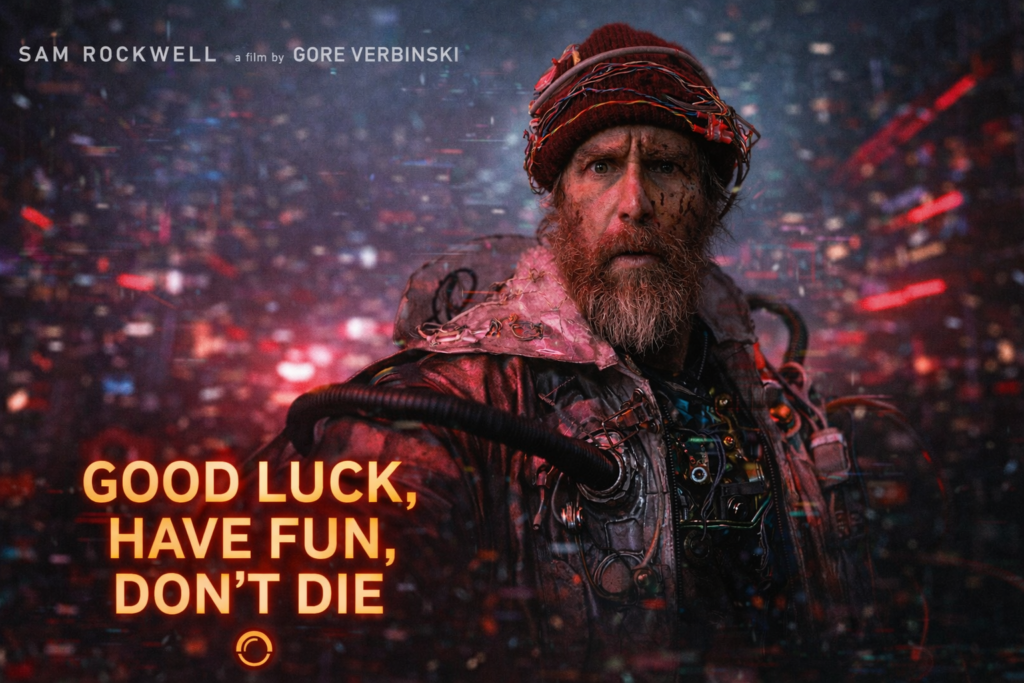
“A razor-sharp, darkly funny sci-fi thriller that respawns the time-loop genre with biting intelligence and visual bravura.”
Introduction
Arcade lights flicker against rain-soaked asphalt. Neon reflections bleed across cracked pavements. Somewhere between a LAN party and the end of the world, reality begins to glitch. “Good Luck, Have Fun, Don’t Die” arrives with a deceptively playful title — gamer shorthand before battle — but what unfolds is far more sinister: a genre-bending sci-fi thriller that fuses existential dread with digital-age satire.
Directed by Gore Verbinski, the filmmaker behind some of the most visually audacious blockbusters of the past two decades, this 2026 release feels like a return to the kinetic, slightly unhinged storytelling that made him such a distinctive cinematic voice. Anchored by a career-best performance from Sam Rockwell, the film morphs from sardonic comedy into metaphysical nightmare with unsettling ease.
The Premise (Spoiler-Free)
Rockwell plays a washed-up competitive gamer turned low-rent tech contractor who stumbles upon an experimental system that blurs the boundary between simulation and reality. At first, it feels like a joke — a cosmic patch update on existence itself. Then people start resetting. Memories fracture. Time loops distort. Death becomes… negotiable.
What begins as a playful nod to gaming culture quickly evolves into something far darker: a meditation on consequence in a world trained to believe every mistake can be undone.
Rockwell in Full Control
Sam Rockwell has always thrived in characters teetering between charm and collapse. Here, he weaponises that volatility. His performance oscillates between manic comic timing and quiet existential terror. Watch his eyes in the later acts — there’s a flicker of dawning horror that no amount of sarcastic quipping can mask.
This isn’t merely another “quirky Rockwell role.” It’s a controlled unraveling. He gives the film emotional ballast even as its reality fractures around him.
Verbinski’s Controlled Chaos
Verbinski directs like a man gleefully bending the laws of physics. The camera glides, then snaps. Scenes reset with subtle visual discrepancies — a glass slightly moved, a shadow cast from the wrong direction. The editing is razor sharp, yet never indulgent. There’s a muscular confidence to the chaos.
Visually, the film feels like a collision between late-night cyberpunk and grounded suburban malaise. Neon palettes contrast with sterile tech interiors. Digital artefacts creep into frame almost subliminally. You start questioning what you’re seeing — exactly as intended.
Theme: The Illusion of the Extra Life
At its core, “Good Luck, Have Fun, Don’t Die” interrogates modern escapism. Gaming culture has normalised retries. Social media has normalised curated identities. AI promises optimisation. The film asks a quietly devastating question: what if permanence returns?
Without heavy-handed speeches, the script explores responsibility, grief, and the seductive danger of consequence-free living. It’s not anti-gaming — far from it — but it does probe the psychological cost of a generation raised on respawns.
Pacing & Execution
The middle act risks repetition — fittingly, given the narrative device — but Verbinski keeps tension escalating by subtly raising emotional stakes rather than merely resetting plot mechanics. Each “loop” becomes more unstable, more dangerous, more human.
The final act avoids bombast. Instead of exploding into CGI excess, it narrows inward. Personal. Intimate. Almost tragic.
Technical Craft
- Cinematography: Sleek, neon-infused, with creeping digital distortions that reward repeat viewings.
- Score: A pulsing electronic undercurrent that gradually fractures into dissonant strings as reality destabilises.
- Production Design: A convincing fusion of indie tech labs, gamer nostalgia, and near-future plausibility.
Verdict
“Good Luck, Have Fun, Don’t Die” could have been a gimmick. Instead, it’s one of 2026’s most unexpectedly thoughtful genre films — funny, unnerving, and philosophically provocative.
It doesn’t just play the game.
It rewrites the rules.
🎬 Verdict Summary Box
| Performances | 9/10 |
| Direction | 8.5/10 |
| Score | 8/10 |
| Cinematography | 9/10 |
| Overall | 8.7/10 |