
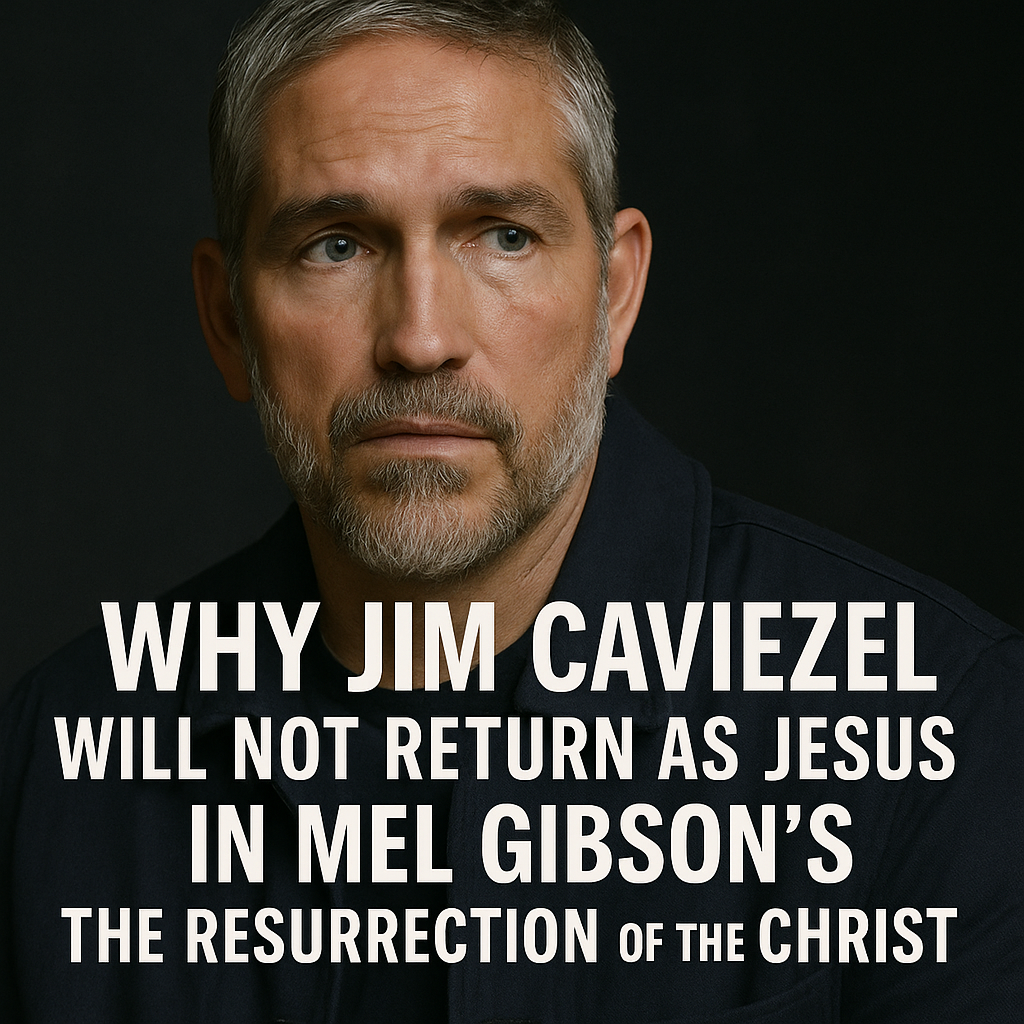
Film critic PDM unpacks the production realities, creative intent, and audience implications behind one of faith cinema’s biggest recasts.
The headline that stunned fans — and why words matter
The moment news broke that Jim Caviezel would not reprise his role as Jesus in Mel Gibson’s long-anticipated follow-up to The Passion of the Christ, the internet split hairs over phrasing: did he “step down,” was he “replaced,” or did the production “move on”? In studio terms, the distinction is crucial. “Stepping down” implies a voluntary exit. What has actually happened is a production-led recast as the project scales into a two-part epic with a refreshed ensemble.
Context: a sequel two decades in the making
The original film’s impact is seismic: a ferociously physical, spiritually committed performance that fused Caviezel’s screen presence with a global audience’s devotion. Two decades later, the sequel begins days after the events of the first film. That narrative proximity creates immediate casting pressure: continuity of character, but not necessarily continuity of actor, especially when the production’s technical and financial calculus changes in pre-production and early photography.
The three pillars of the recast
1) The age–timeline mismatch
The Resurrection story resumes mere days after the crucifixion. No amount of training, makeup, or modest digital touch-up can fully reconcile a twenty-year gap on a face audiences know frame-by-frame from 2004. De-aging is possible, but it introduces costs, continuity questions, and visual-effects risk across long sequences. For a film that wants to feel immediate and elemental, the cleanest path is to hire an actor who simply reads “right now” for those three-days-later scenes.
2) Budget and VFX pragmatism
High-end de-aging at feature length is expensive and time-intensive — and it compounds if multiple legacy characters return. Even if the craft succeeds, audiences can sense when a performance is routed through a pipeline of digitally altered frames. Opting for a younger lead and a new principal ensemble redirects resources toward production design, location work, and the metaphysical sequences the director has promised, rather than tying the schedule to heavy post-processing.
3) A bolder creative brief
The new films are described in strikingly visionary terms — an experiential journey through the metaphysical dimensions surrounding the Resurrection. That ambition invites a tonal reset: new faces, new textures, and a visual grammar less tethered to the physical ordeal of the first film and more attuned to the spiritual, psychological, and otherworldly. A fresh cast clarifies that tonal pivot for viewers the second the trailer begins.
Timeline clarity — and the new face of Jesus
For years, Caviezel publicly expressed willingness to return. But as the sequel’s scope expanded and schedules crystallised, the production took a different path. In October 2025, the role formally passed to Finnish actor Joo Otin, whose quiet intensity reportedly aligns with the sequel’s transcendent tone. The change underscores the project’s commitment to narrative realism and a unified aesthetic across its planned two-part structure.
“But he wanted to return” — reconciling earlier signals
Over the years, Caviezel spoke about his readiness to step back into the role. Fans reasonably expected him to return, and for a time that seemed plausible. What changed is not his interest, but the production’s risk–reward equation once the scope expanded, the delivery strategy crystallised, and the calendar locked. In that calculus, a recast is not a repudiation of an actor; it’s an optimisation of story requirements, schedule pressure, and the film’s long tail.
Caviezel’s four themes — the theology behind his craft
Caviezel has often framed portraying Christ through four interwoven truths: reverent fear (awe that burns away ego), suffering transformed into meaning (wounds as prayer, pain as pathway), spiritual warfare (expecting resistance when bringing Christ to the screen), and surrender (letting the message eclipse the messenger). Those themes shaped his preparation — confession, fasting, prayer — and they also set the emotional key the sequel aims to sustain, even with a new lead.
The human dimension: legacy without repetition
Caviezel’s performance achieved what few screen portrayals ever do: it became a devotional image. Recasting does not erase that; it protects it. Asking the same actor to reproduce the identical physical and spiritual temperature two decades later risks diminishing what made the original singular. Preserving legacy sometimes means leaving it intact and building the sequel’s power on different creative foundations.
Audience impact: continuity vs. credibility
Faith-driven viewers often prize continuity — the comfort of a familiar face — yet credibility matters more. A Jesus who looks precisely as he did “last week” in story time should feel visually truthful. If the new actor is convincing in the first thirty seconds, audience resistance tends to dissolve. The bigger danger isn’t recasting; it’s an uncanny valley that distracts from the spiritual core. The production has chosen the safer path for immersion.
Industry lens: what the recast signals
- Priority on photographic realism over digital retrofits for principal characters.
- Resource reallocation toward world-building, performance, and metaphysical set-pieces rather than a wall-to-wall VFX facelift.
- Two-part event strategy that benefits from a cohesive, age-appropriate ensemble able to sustain rigorous shooting and post schedules.
In other words, the decision is less about nostalgia and more about delivering a credible, contemporary epic that can play to global audiences beyond the already-converted.
What success looks like now
The sequel’s measure won’t be whether it reunites every original face; it will be whether it moves audiences with integrity — whether its Jesus feels lived-in, whether its portrayal of the disciples invites identification, whether its metaphysical sweep lands with awe rather than abstraction. If those notes are struck, the recast becomes a footnote rather than a fault line.
Final verdict
Recasting Jesus after one of the most indelible performances of the century is a high-wire act. But given the story’s immediate timeline, the financial and technical realities of feature-length de-aging, and the director’s expansive vision, it is also the most disciplined choice. Caviezel’s legacy remains intact; the sequel earns room to become its own work of art.
And in a reflective sense, the moment feels fitting: Caviezel long insisted the message should outshine the messenger. His quiet acceptance of the change mirrors the Resurrection’s own logic — relinquishment before renewal. The story continues, the light remains, and faith finds new faces through which to shine.
Movieversalfilm — Your AI-powered entertainment magazine for the UK & US.