
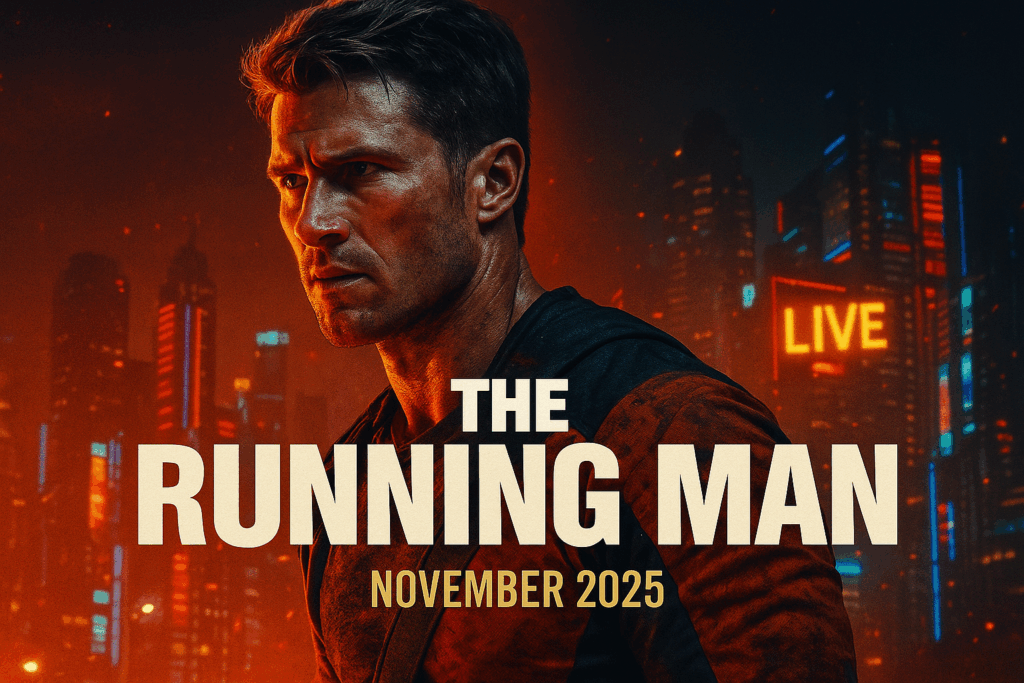
There are game shows, and then there are battlegrounds. “The Running Man” returns in a deadly new broadcast — a future where entertainment feeds on the poor and justice is sold to the highest bidder. Director Edgar Wright takes this once-satirical concept and modernises it for 2025: cameras everywhere, public votes controlling lives, media corporations tightening their grip on truth. And from the opening chase, it’s clear — brutality has become prime-time.
“A ferocious, crowd-roaring spectacle — and one that asks whether we are the real problem.”
Cinematic Review
Wright’s adaptation draws closely from Stephen King’s original novel. The United States is politically fractured, its economy gutted, and corporate-media has stepped into government’s shoes. Audiences don’t just watch the show — they control the kill switch.
Glen Powell leads as Ben Richards — everyman turned outlaw, a father forced to gamble his life for a cure his daughter desperately needs. With debt crushing him and desperation mounting, he enters “The Running Man,” a televised manhunt where surviving for 30 days means a fortune… if he isn’t killed by state-sanctioned Hunters first.
Powell’s performance is charismatic but grounded. He’s sculpted into a modern action hero, yet his vulnerability hits hardest. He is exhausted, angry, scared — a man fully aware the world wants him dead, and still refusing to bow.
Colman Domingo adds electric menace as Bobby Thompson, the showman-host who weaponises charisma with chilling ease. Josh Brolin portrays Dan Killian — a ruthless, calculating executive whose smile hides the machinery of a dystopia.
Visually, the film is a sensory overload: neon-slick streets, chaotic urban chases, surveillance screens blinking like predatory eyes. Cinematographer Chung-hoon Chung balances feverish handheld tension with blockbuster scope, while Paul Machliss’ editing turns every escape into a rhythmic surge of adrenaline.
Themes Sharpened for 2025
Wright updates the core message: entertainment has become a weapon. Where the 1987 adaptation embraced spectacle, this version asks uncomfortable questions:
- Are we desensitised to human suffering?
- How much of our privacy have we already traded away?
- If society collapses, will we cheer… or change the channel?
“The Running Man” is most effective when exposing the voyeurism of the audience — the world not only wants Richards dead… they want to decide how.
The World Of The Running Man Featurette – Courtesy Of Paramount Pictures
Where It Stumbles
The film occasionally wrestles with its own ambition. Wright attempts to merge large-scale action, media satire, and emotional commentary into one explosive package. Not every thread lands with equal force. Some emotional beats arrive quickly and vanish just as fast. And while the social commentary is present, the barrage of spectacle can overpower the bigger message.
Still, even these flaws contribute to a relentless ride that never underestimates viewer intelligence.
A Modern Popcorn Thriller With Teeth
For action fans, this is a gleaming gift. For audiences wanting social critique, there is substance beneath the fireworks. And for those who appreciate the original King story, Wright delivers a version far closer to that book’s dystopian DNA.
By the time the credits roll, you’ll be out of breath — and maybe a little uneasy about every screen staring back at you.
Verdict Summary Box
| Performances | 8.0 / 10 |
| Direction | 7.5 / 10 |
| Score | 7.0 / 10 |
| Cinematography | 8.5 / 10 |
| Overall | 7.8 / 10 |
Trailer Courtesy Of Paramount Pictures