
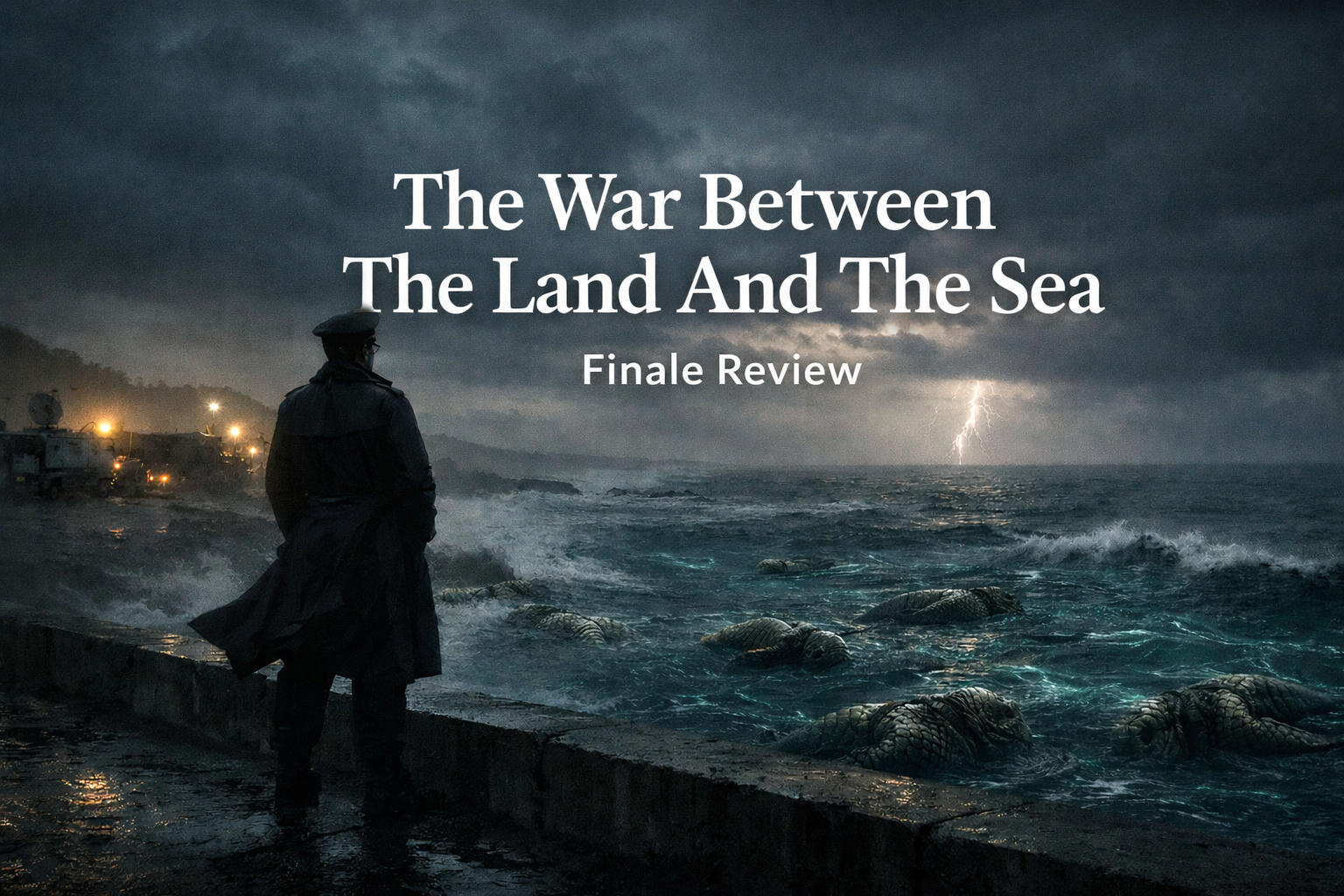
The sea is calm now. Too calm.
After weeks of rising tension, political paranoia, and ancient forces clawing their way back into relevance, The War Between the Land and the Sea closes not with spectacle alone, but with consequence. This finale understands something Doctor Who spin-offs often forget: endings don’t need to shout if they can haunt.
“This wasn’t just a UNIT story. It was a reckoning — for power, identity, and the cost of survival.”
The Finale: A Quiet Cataclysm
The final episode resists the temptation to become a standard Whoniverse fireworks display. Instead, it leans into atmosphere, moral ambiguity, and irreversible decisions. The threat is vast, but the drama is intimate — played out through command rooms, fractured loyalties, and moments of silence where the weight of what has been unleashed truly lands.
What makes the finale effective is its refusal to offer easy absolution. Victories are compromised. Losses linger. The world is saved, yes — but not restored. This is a story that understands the sea does not forget what was done to it.
UNIT Under Pressure
At its core, the finale is about UNIT confronting the limits of authority. The series has steadily dismantled the idea that military certainty equals moral clarity, and the final chapter completes that arc with confidence. Orders are questioned. Lines are crossed. And the consequences feel earned rather than contrived.
Leadership in this episode is portrayed as isolating rather than empowering — a choice that gives the finale emotional credibility and distances it from more conventional franchise endings.
Tone, Direction and Atmosphere
Visually, the episode is striking without being indulgent. Coastal locations are framed as liminal spaces — neither safe nor hostile, but watching. The direction favours restraint over excess, allowing sound design, pacing, and performance to carry the tension.
The score deserves particular praise. It avoids heroic bombast, instead favouring low, mournful textures that underline the sense that something ancient has been disturbed… and may never fully retreat.
Performances: Humanity in the Storm
The cast delivers across the board, but the finale belongs to the ensemble rather than any single character. This is a story about systems under strain, not lone saviours. Emotional beats are played with maturity, trusting the audience to feel the loss without underlining it.
Crucially, the episode understands when not to speak. Several of its most powerful moments occur in silence — a rare confidence move in modern genre television.
The Verdict on the Finale
As a closing chapter, this finale succeeds because it respects the intelligence of its audience. It doesn’t reset the board. It doesn’t tidy away the mess. It leaves the Whoniverse altered — politically, emotionally, and thematically.
This is not an ending designed to reassure. It is an ending designed to endure.
Finale Verdict Summary
- Performances: 9/10
- Direction: 8.5/10
- Writing: 8.5/10
- Atmosphere & Score: 9/10
- Finale Episode Overall: 8.8/10
Series Overview: The Whoniverse Grows Up
Across its run, The War Between the Land and the Sea has proven to be more than a spin-off — it is a tonal evolution for the Whoniverse. Grounded, political, and unafraid of ambiguity, the series rejects monster-of-the-week simplicity in favour of long-form consequence.
It treats Earth not as a backdrop for alien invasions, but as a participant in cosmic history — with institutions, cultures, and mistakes that matter. By centring UNIT not as heroes but as conflicted custodians, the show earns its dramatic weight
Most importantly, the series trusts its audience. It assumes viewers can handle unresolved questions, moral discomfort, and an ending that changes the status quo rather than preserving it.
Overall Series Verdict
The War Between the Land and the Sea stands as one of the most confident and mature entries in modern Doctor Who-adjacent storytelling. It expands the Whoniverse not by spectacle, but by depth.
This is what spin-offs should do.
Series Verdict Summary
- Concept & World-Building: 9/10
- Writing Consistency: 8.5/10
- Performances: 8.5/10
- Direction & Tone: 9/10
- Overall Series Score: 8.7/10