
A strange noise in the hallway is one thing. Your mother’s face waiting at the end of it is another. Other Mommy takes that most comforting childhood certainty — Mum is here — and gives it a terrible second meaning. Recognising the person in front of you becomes the beginning of the problem.
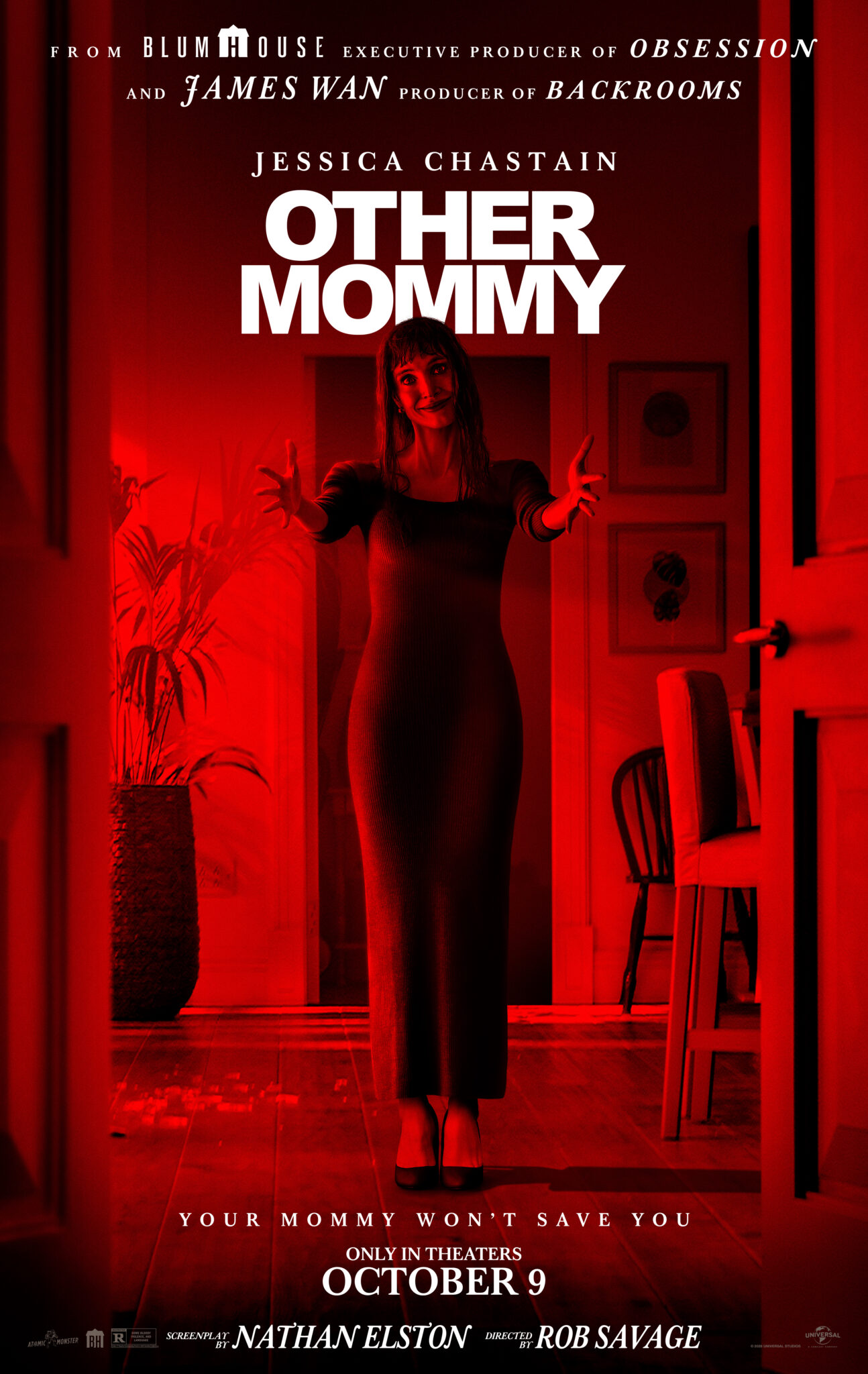
The most frightening thing a monster can borrow is your trust.
Movie at a Glance
- Film: Other Mommy (2026)
- Genre: Supernatural horror
- Director: Rob Savage
- Screenplay: Nathan Elston, adapted from Josh Malerman’s Incidents Around the House
- Principal cast: Jessica Chastain, Arabella Olivia Clark, Jay Duplass, Dichen Lachman, Arian Moayed and Karen Allen
- Runtime: Approximately 93–94 minutes, depending on the territory listing
- Classification: R (US); 15 (UK)
- US and UK cinema release: 9 October 2026
- Distributor: Universal Pictures
Viewer Match
- Best for: Horror fans intrigued by maternal doubles, creature performances and elaborate supernatural scares.
- Maybe skip if: Your priority is carefully developed mythology or an emotionally sustained family drama.
- Mood and pace: Domestic anxiety gives way to more overt supernatural spectacle.
- Cinema or streaming? The cinema offers the communal appeal of a jump-scare film; anyone primarily seeking psychological depth may prefer to wait. No streaming date is confirmed here.
- Spoiler level: Premise and broad craft discussion only; no ending or major set-piece revelations.
A family home with a terrible vacancy
Young Bela encounters a presence that resembles her mother, while tensions already trouble the family around her. The entity’s apparent familiarity is the essential hook. It arrives wearing the face of someone she has every reason to trust.
That premise has an uncomfortable logic. Children learn safety through repetition: a voice calling from downstairs, a hand reaching across a table, a familiar silhouette outside a bedroom. A maternal impostor comes equipped with all those reassuring signals. There is something particularly nasty about a threat that can make asking for comfort feel like taking a risk.
The family setting also supplies more than a convenient address for a haunting. Adult unhappiness creates gaps that a child cannot necessarily explain. In that space, affection becomes a vulnerability. The concept asks an unnerving question: what happens when something dangerous understands your need to be loved?
Jessica Chastain and the horror of almost human
Chastain’s double casting gives the film its strongest immediate attraction. Her commitment to the entity’s physical performance emerges as a consistent point of interest in the available criticism: posture, expression and unnatural movement help turn a recognisable face into a threat.
It is a smart casting idea because recognition does much of the work. Horror need not invent an entirely new species to unsettle us. Sometimes the disturbing detail is the tiny distance between a gesture we know and a gesture that feels wrong. A smile offers reassurance until it seems to have forgotten why people smile.
There is, however, a limit to what an arresting performance can repair. The criticism also points to restricted character development. The family needs sufficient dramatic life for its disintegration to hurt; a prestigious cast cannot supply every missing connection through presence alone.
Rob Savage builds the shocks — but can they build a story?
Savage’s direction is described as visually ambitious, with a strong opening and an appetite for elaborate horror sequences. The less encouraging thread concerns how the film connects those sequences. Its supernatural rules and emotional stakes appear less developed than its mechanisms for startling the audience.
That distinction matters. A shock is an event. Dread is a relationship between events: what we remember, what we expect, and what we are afraid to see confirmed. Put enough shocks close together and the audience may become very alert without becoming deeply invested.
The reported movement towards familiar paranormal investigation further complicates the film’s identity. An intimate fear of maternal replacement risks losing its individuality when the story turns towards more conventional supernatural problem-solving. The premise invites uncomfortable uncertainty; the machinery of a haunted-house thriller demands forward motion.
When the house becomes part of the monster
Lowell A. Meyer’s cinematography and the threatening treatment of domestic spaces receive particular praise. Confined framing and shifts in perspective support Bela’s vulnerability. Practical creature work contributes to the entity’s disturbing physical presence, although the increasing digital spectacle has also drawn criticism.
A doorway is an especially useful horror shape. It divides what can be seen from what might be waiting. In a story organised around a child’s insecurity, ordinary rooms carry unusual dramatic weight: they are places that should already have been declared safe.
The challenge is preserving that scale of fear. An impossible body can hold our attention, but the emotional question remains smaller and more intimate: can Bela trust the person approaching her? The film’s most persuasive selling point lives in that question, regardless of how much supernatural activity fills the frame.
Family fractures beneath the fright machine
Motherhood, marriage and the discovery that parents have complicated lives give Other Mommy substantial thematic possibilities. Its central image makes those ideas accessible without requiring a lecture. The danger wears a parent’s face; the child must interpret the difference.
The available reviews suggest that these possibilities are not developed as fully as the scares. That leaves a familiar frustration: an intriguing dramatic premise supporting a more conventional genre experience. There is room for pleasure in the construction, particularly for viewers who enjoy creature work, but psychological horror asks for an emotional residue that spectacle alone cannot guarantee.
The weakness is not simply a shortage of running time. It is the lack of emotional carry-over between incidents: when a frightening encounter gives way too quickly to the next attraction, the experience can resemble a haunted-house tour. There is always another room, but too little time to absorb what happened in the last one.
Music, sound and the spaces between the screams
The music offers a more encouraging element of the film’s construction. Discordant, distorted cues contribute atmosphere, while the sound design distinguishes Bela’s encounters with the entity from her interactions with people. That gives the supernatural a separate sensory identity rather than leaving the images to carry every change in reality.
The editing attracts a less favourable assessment. The movement between set pieces can leave character reactions feeling abbreviated, weakening the connection between physical danger and its emotional consequences. Horror needs rhythm, but it also needs an aftermath. A child should not seem to have recovered from a nightmare simply because the next scene has begun.
Spoiler-Free Verdict
A compelling face for an uneven nightmare. Chastain’s physical commitment and the film’s visual imagination are its strongest attractions. The screenplay gives them too little emotional substance to make this an essential horror recommendation.
Provisional Editorial Scorecard
- Performances: 7/10 — Committed central performances, constrained by thin characterisation.
- Direction: 5/10 — Visual invention without equally sustained tension.
- Screenplay: 4/10 — An arresting premise with underdeveloped emotional and supernatural logic.
- Score: 6/10 — Atmospheric dissonance supports the film’s unsettling mood.
- Cinematography: 7/10 — Perspective and confined spaces give the threat visual force.
- Entertainment Value: 5/10 — Creature spectacle offers interest, but the dramatic returns are uneven.
- Overall: 5/10 — Craft and commitment cannot fully compensate for weak storytelling.
Overall: 5/10 · 2.5/5 stars
Skip It
Dedicated fans of Chastain or elaborate creature work may find enough to investigate. For viewers seeking sustained psychological horror, this is a difficult film to prioritise.
Watch the Official Trailer
Meet Bela’s unnerving visitor in the official second trailer.
Which unsettles you more: a monster you cannot recognise, or someone you recognise a little too well? Share your spoiler-free thoughts.