
Six decades after a risky television experiment began, Star Trek still makes a compelling case for curiosity, courage and a future worth building.
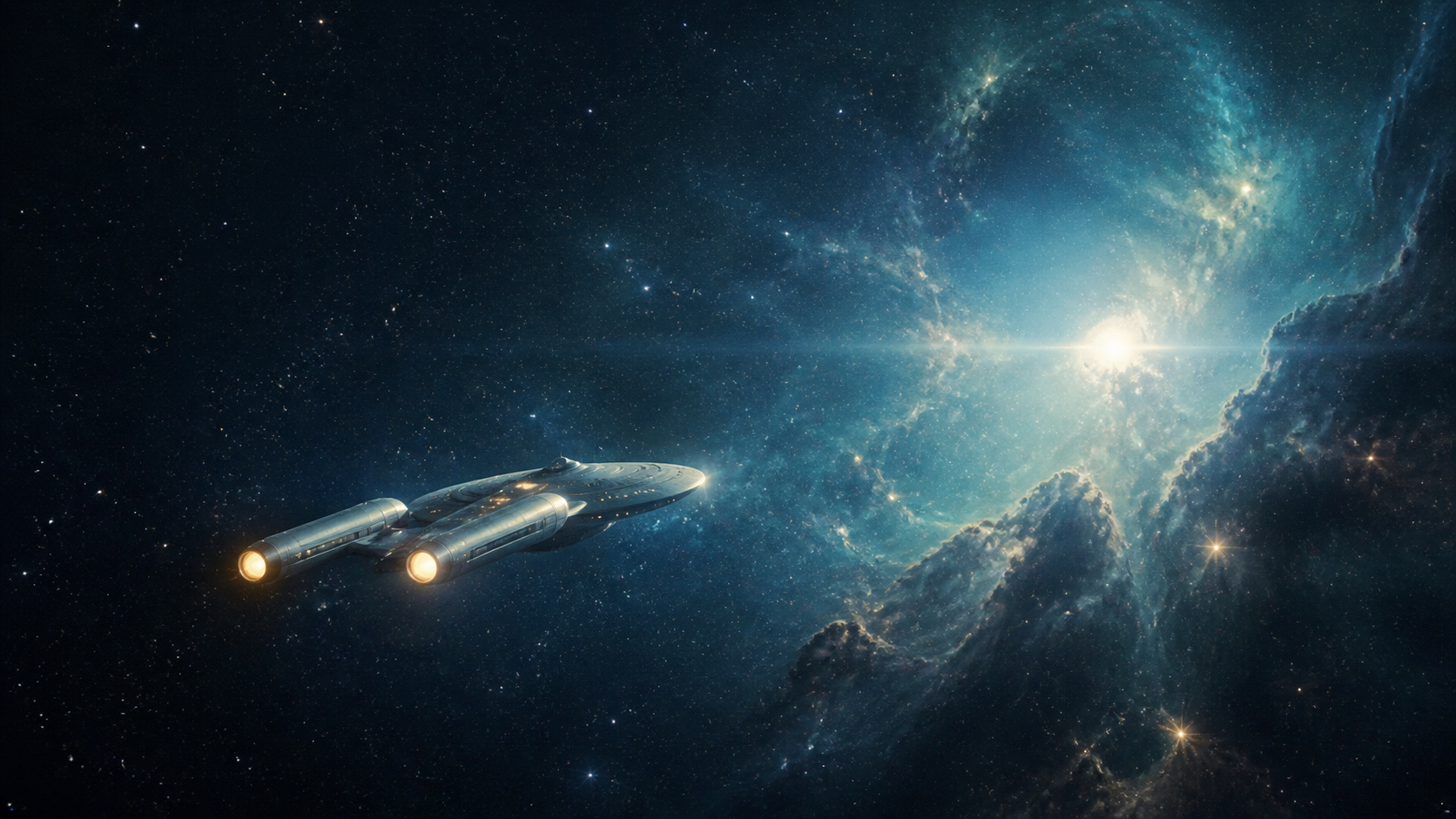
Star Trek at 60: Part 1
- Series: Star Trek at 60 — Part 1 of 3.
- Period covered: 1966–1986.
- Format: Spoiler-free anniversary feature.
1966–1986: THE IMPOSSIBLE VOYAGE THAT REFUSED TO DIE
Space. The Final Frontier.
There are television programmes that become hits.
There are television programmes that become classics.
And then there is Star Trek.
On 8 September 1966, NBC broadcast an unassuming science-fiction adventure called “The Man Trap.” It introduced American television viewers to Captain James T. Kirk, Mr Spock, Dr Leonard “Bones” McCoy and the crew of a starship called the USS Enterprise NCC-1701.
Nobody watching that night could have known they were witnessing the launch of a cultural phenomenon that would still be expanding six decades later.
Yet here we are.
On 8 September 2026, Star Trek celebrates its 60th anniversary, and Paramount has appropriately chosen “Space for Everybody” as the theme of its year-long celebration: hope, exploration and the invitation to be bold.
It is difficult to imagine a phrase that better describes what Star Trek ultimately became.
Because Trek was never really about space.
Space was simply where Gene Roddenberry hid the mirrors.
BEFORE KIRK, THERE WAS PIKE
The Enterprise first slipped her moorings long before William Shatner sat in the captain’s chair.
Production began on Star Trek’s original pilot, “The Cage,” in November 1964. Jeffrey Hunter played Captain Christopher Pike, Majel Barrett was the mysterious Number One and Leonard Nimoy was already aboard as an unusually emotional version of Spock.
NBC rejected the pilot.
But something extraordinary happened.
Rather than simply killing the project, the network ordered a second pilot — an unusual vote of confidence. Gene Roddenberry reconfigured the crew, increased the action and produced “Where No Man Has Gone Before.”
That second attempt sold Star Trek.
And there is another person who deserves a seat at this particular captain’s table.
Lucille Ball.
Yes. That Lucille Ball.
Her Desilu Productions backed Roddenberry when others were reluctant, supporting the expensive project through two pilots despite the enormous financial risk. Without Desilu — and Ball’s willingness to gamble — there is a very plausible universe in which Star Trek never reaches television at all.
Somewhere in the multiverse there is therefore a monument reading:
LUCY, WE HAVE A STARSHIP.
GENE RODDENBERRY’S GREAT IDEA
Roddenberry famously conceived Trek partly as a “Wagon Train to the stars” — a format that allowed a starship to encounter a new society, conflict or mystery every week.
But underneath the television pitch was something considerably more ambitious.
Humanity had survived.
That was the radical proposition.
The 1960s were dominated by the Cold War, racial conflict, Vietnam, political assassination and the very real possibility of nuclear annihilation.
Roddenberry looked past all of it and said:
We make it.
Not perfectly.
Not without war.
Not without tragedy.
But humanity grows up.
Poverty can be overcome.
Race need not divide us.
Nationalities can serve together.
Science and curiosity can outrank superstition and fear.
Humankind can become part of something larger than itself.
This future included a Japanese helmsman, a Russian navigator at the height of the Cold War, a Black female communications officer on the bridge and an alien science officer who constantly challenged human assumptions.
Star Trek did not invent every progressive idea attributed to it, and some popular claims about television “firsts” have become exaggerated over the decades.
Its significance is nevertheless undeniable.
The bridge of the Enterprise presented television audiences with an image of humanity working together when much of the real world seemed determined to do precisely the opposite.
THE HOLY TRINITY OF TREK: KIRK, SPOCK AND McCOY
The original Star Trek eventually discovered that its greatest special effect wasn’t the transporter.
It wasn’t the Enterprise.
It wasn’t even those polystyrene rocks that could apparently survive a photon torpedo.
It was the relationship between three men.
Kirk.
Spock.
McCoy.
Together they created one of popular culture’s great dramatic triangles.
Kirk was decision.
Spock was reason.
McCoy was conscience and emotion.
Spock would calculate the logical course.
McCoy would remind everybody that the logical course might be morally intolerable.
And Kirk would have approximately four seconds to decide which of them was right while the Enterprise exploded around him.
It worked because Kirk was not merely the reckless intergalactic womaniser popular caricature subsequently turned him into.
Watch the original series properly and Kirk is an intellectual officer: strategic, bookish, decisive and acutely aware that hundreds of lives depend upon him.
Spock, meanwhile, became the show’s great outsider.
Half Vulcan.
Half human.
Never completely belonging to either world.
SPOCK: THE SOUL WHO INSISTED HE DIDN’T HAVE ONE
Few fictional characters have escaped their original medium as completely as Spock.
The pointed ears became instantly recognisable.
The Vulcan salute became part of international popular culture.
“Live long and prosper” became something approaching a secular blessing.
But Spock endured because Leonard Nimoy gave the character something much deeper than alien eccentricity.
Spock’s lifelong argument was with himself.
His Vulcan upbringing demanded logic, emotional discipline and control.
His human inheritance refused to disappear.
Episodes such as “Amok Time” exposed the biological and emotional forces beneath his carefully maintained restraint.
Spock claimed logic ruled him.
McCoy knew better.
Kirk knew better.
And eventually Spock knew better too.
That conflict culminated magnificently in Star Trek II: The Wrath of Khan, when the most “logical” member of the Enterprise crew made an intensely loving choice:
the life of the individual sacrificed for the lives of his friends.
You know the line.
We don’t even need to quote it.
Trekkies are already hearing James Horner’s score.
THE REST OF THE ENTERPRISE CREW
The original Enterprise worked because its bridge did not present a one-man future.
Hikaru Sulu made the helm feel like a place of precision and calm; George Takei gave him the quiet authority of an officer who belonged there. Nyota Uhura, played by Nichelle Nichols, made the communications station one of television’s most consequential seats. Her presence on the bridge did not need a speech to make a point: the future had room for her.
Pavel Chekov arrived in the second season, a young Russian navigator at the height of the Cold War. Walter Koenig’s character became a small but potent reminder that Trek’s imagined future could make former geopolitical enemies colleagues.
Montgomery Scott was the engineer who made impossible rescues sound like a difficult afternoon. James Doohan made Scotty the crew’s practical miracle worker: the man who could coax one more burst of power from a ship whenever the plot, the captain or the laws of physics required it.
And Nurse Christine Chapel, played by Majel Barrett, became more important as Trek returned to her era. She was never merely background medical staff: Chapel brought compassion, resilience and a complicated emotional life to the Enterprise. Together, these officers made Roddenberry’s future feel inhabited rather than merely announced.
AND THEN THERE WAS THE ENTERPRISE
Star Trek has had wonderful characters.
But one of its greatest characters has no dialogue.
NCC-1701.
No bloody A, B, C or D.
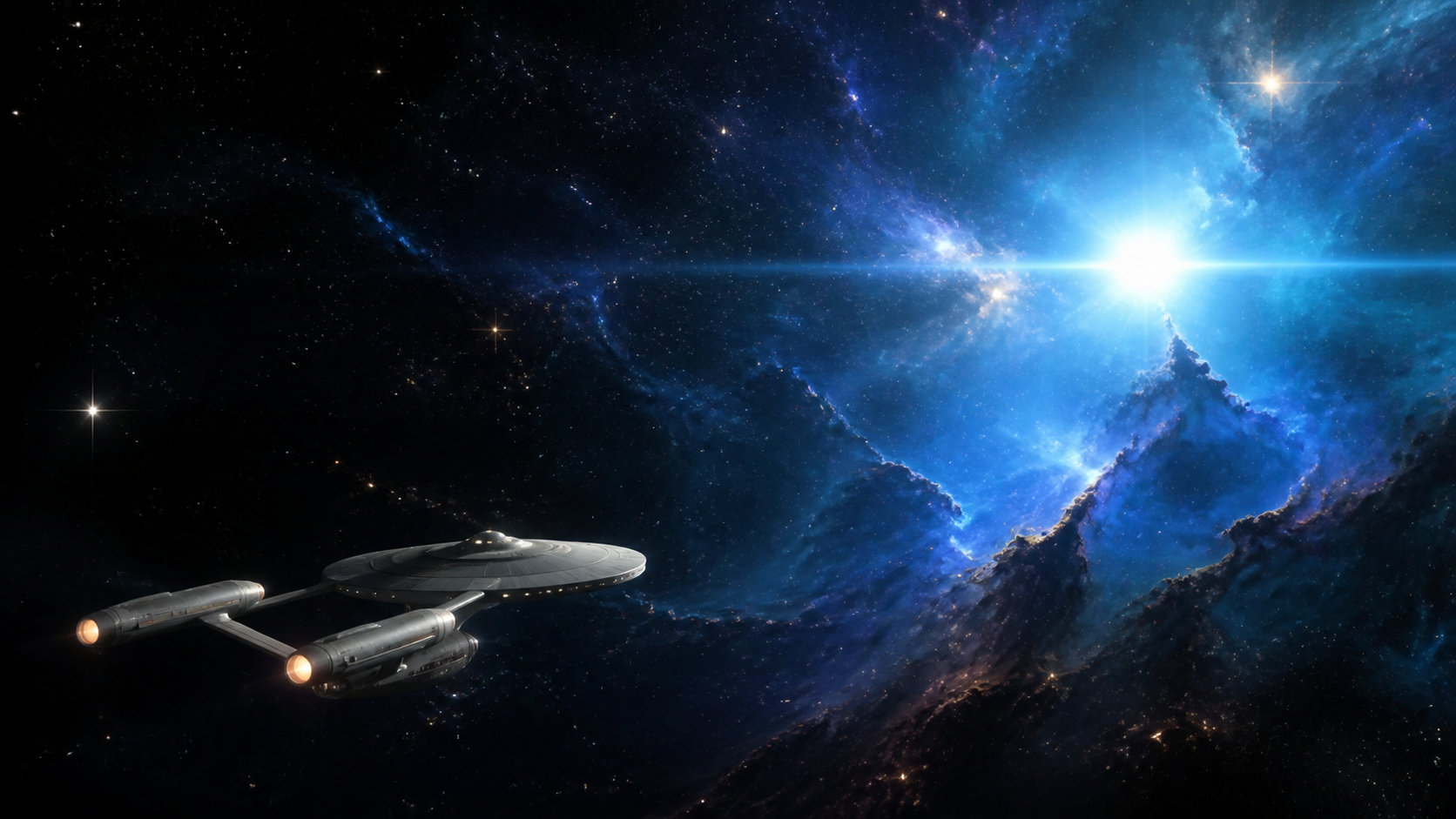
The original USS Enterprise was designed by Walter “Matt” Jefferies, who deliberately avoided the visual language of contemporary rockets and existing science-fiction spacecraft.
The result was startlingly elegant: a saucer, engineering hull, two long warp nacelles and almost nothing resembling a conventional aircraft.
The famous original filming miniature was approximately 11 feet long and would eventually enter the Smithsonian National Air and Space Museum collection.
That tells you something.
The Enterprise is technically a prop from a cancelled television series.
Yet it resides alongside artefacts from humanity’s real exploration of space.
Because the Enterprise helped inspire some of the people who pursued that exploration.
Roddenberry understood something fundamental.
A starship should not simply carry the characters.
It should represent them.
Enterprise was humanity travelling together.
When she swept across a television screen in 1966, she was not merely going somewhere.
She was carrying an argument about what humanity might become.
THE ENEMIES AT THE FRONTIER
Of course, enlightenment becomes rather difficult when somebody is firing disruptors at you.
And Star Trek created some magnificent adversaries.
The Klingons
The Klingons began as Cold War opponents of the Federation.
Aggressive.
Expansionist.
Militaristic.
Their evolution across six decades would become one of Star Trek’s richest pieces of political world-building.
The Klingons of the 1960s gradually became the honour-driven warrior culture seen in the films and The Next Generation.
Eventually one of them — Worf, son of Mogh — would serve on the bridge of a Federation flagship.
Think about that transformation.
Yesterday’s enemy becomes tomorrow’s crewmate.
That may be one of the most profoundly Star Trek ideas of all.
The Romulans
If the Klingons were the enemy you could hear approaching, the Romulans were the enemy who might already be standing behind you.
Introduced in “Balance of Terror,” they were secretive, strategic and politically sophisticated.
And then came the revelation that changed everything:
Romulans and Vulcans were related.
Logic and passion.
Two civilisations descended from common origins but separated by ideology.
Very Trek.
Harry Mudd
Then there was Harcourt Fenton “Harry” Mudd.
Smuggler.
Conman.
Fraud.
Entrepreneur — according to Harry.
Public menace — according to almost everybody else.
And no, despite occasional misremembering, he wasn’t actually “Captain Mudd.”
Although I wouldn’t put it past him to have business cards printed.
Mudd provided something essential to Trek: proof that humanity’s journey towards enlightenment had apparently failed to eliminate dodgy salesmen.
KHAN.
One name.
That’s enough.
Khan Noonien Singh first appeared in the 1967 episode “Space Seed.”
A genetically engineered tyrant from Earth’s Eugenics Wars, Khan possessed enormous intelligence, strength, charisma and perhaps the most formidable chest ever to emerge from a Starfleet transporter room.
But Khan’s immortality was secured 15 years later.
Star Trek II: The Wrath of Khan transformed a television antagonist into one of cinema’s great villains.
Ricardo Montalbán’s Khan wasn’t interested in destroying the universe.
He wanted Kirk.
Revenge gave the film intimacy.
Age gave it melancholy.
Death gave it consequence.
And the result is still widely regarded as a benchmark against which Star Trek cinema is measured.
Sixty years later, Trek is even revisiting Khan’s years on Ceti Alpha V through the scripted Star Trek: Khan audio series.
Some grudges really do have legs.
CANCELLED — BUT NOT DEAD
NBC cancelled Star Trek in 1969 after three seasons and 79 episodes.
Normally that should have been the end.
Instead, Star Trek performed its first resurrection.
Syndicated repeats introduced the programme to huge numbers of viewers who had missed it.
Fans organised.
They wrote.
They debated.
They produced fanzines.
They created clubs.
And in January 1972, an early dedicated Star Trek convention in New York expected hundreds and attracted thousands.
This was no longer merely an audience.
It was becoming a culture.
Star Trek returned as The Animated Series in 1973.
Then, after the seismic success of Star Wars changed Hollywood’s appetite for space adventure, Star Trek finally reached cinema.
Star Trek: The Motion Picture arrived in 1979.
The uniforms were questionable.
The pacing occasionally travelled at impulse power.
But the Enterprise was back.
And three years later The Wrath of Khan demonstrated that Trek could become emotionally powerful cinema.
The Search for Spock followed.
Then, in 1986, Star Trek did something wonderfully absurd.
It sent Kirk and his crew back to contemporary San Francisco to rescue humpback whales.
Star Trek IV: The Voyage Home proved Trek could be funny, accessible, environmental and enormously entertaining without betraying itself.
A franchise once cancelled for insufficient ratings had become a cinematic institution.
And it hadn’t even reached its greatest period of expansion yet.
CONTINUED IN PART 2 – COMING SOON
Movieversalfilm Verdict
At its best, Star Trek remains less a catalogue of ships and catchphrases than an argument for humane curiosity — one still worth making.
Which era of Star Trek first made the final frontier feel like home?
Part 2 Coming Soon