
Oak Street looks like the sort of American cul-de-sac built to keep danger at a comfortable distance. In The End of Oak Street, David Robert Mitchell turns that promise of safety inside out, driving a lean family drama through the teeth of a ferocious suburban creature feature.
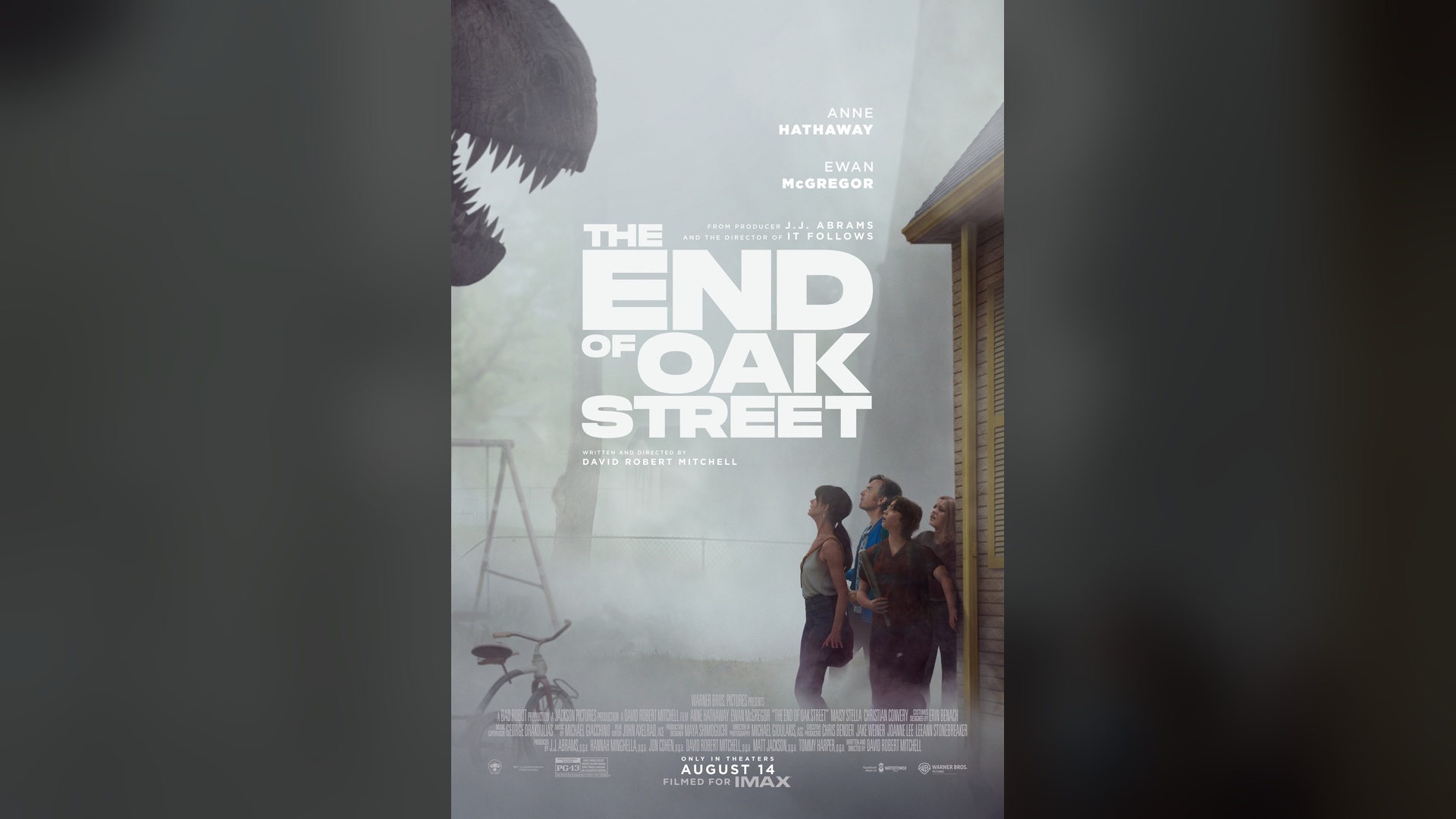
A quiet cul-de-sac becomes a pressure cooker where family fractures and prehistoric teeth arrive at the same door.
Movie at a Glance
- Film: The End of Oak Street (2026)
- Release: US and UK cinemas, 14 August 2026
- Distributor: Warner Bros. Pictures
- Writer and director: David Robert Mitchell
- Starring: Anne Hathaway, Ewan McGregor, Maisy Stella and Christian Convery
- Runtime: 99 minutes
- US rating: PG-13
- Format: Filmed for IMAX
- Genre: Science-fiction survival thriller
A Street Built for Suspense
Mitchell understands that a familiar space becomes unnerving the moment its geography stops behaving as expected. Houses, driveways and clipped lawns are arranged with almost architectural clarity before the film begins tightening its grip. The director’s camera is patient enough to make the audience search the frame, then suddenly mobile when the threat breaks cover. Long takes and split-diopter compositions give the action a tactile, slightly old-fashioned confidence, while Michael Gioulakis’s cinematography finds menace in both open daylight and domestic shadow.
That control matters because the premise could easily have collapsed into knowingly disposable chaos. Instead, the film treats its prehistoric intruders with weight and danger. The visual effects are strongest when they serve movement and scale rather than spectacle for its own sake: a glimpse across a garden, the disruption of an ordinary street, the sickening sense that walls and cars offer only temporary protection. Maya Shimoguchi’s production design helps the neighbourhood feel inhabited before it becomes a battleground, giving every damaged corner a little more consequence.
A Family Drama with Teeth
Anne Hathaway gives the film its centre of gravity. She plays fear as something active rather than decorative, letting resolve harden in real time without turning the character into an invulnerable action figure. Ewan McGregor brings a contrasting weariness and unease, and the friction between the adults gives the danger an emotional pressure beyond simple survival. Maisy Stella and Christian Convery are not treated as cargo to be moved between set pieces; their reactions and decisions help define the family as a volatile unit with its own fault lines.
The performances keep the film sincere even when the mechanics become exuberantly pulpy. At heart, this is about a household forced to decide what it will protect when all its routines and resentments become irrelevant. Mitchell does not overstate that idea, but it gives the best sequences a useful double charge: the characters are running from creatures while also running out of ways to avoid one another. Michael Giacchino’s score supports that balance, supplying propulsion and scale without smothering the smaller beats of anxiety.
Momentum over Explanation
The screenplay is less persuasive when it pauses to explain why this is happening. Its science-fiction logic is deliberately light, and a few decisions feel arranged to keep the characters in danger rather than emerging naturally from who they are. The film also asks the same basic survival question more than once, which can make the middle stretch feel like a series of variations on an exceptionally well-staged chase.
Yet the pace is brisk enough that these weaknesses rarely become fatal. John Axelrad’s editing keeps the film compact and legible, allowing tension to accumulate without chopping the action into noise. The third act pushes the story towards broader, more divisive territory, trading some of the early restraint for scale. It does not land every idea cleanly, but the commitment is admirable: this is a studio creature feature willing to be strange, earnest and occasionally savage rather than merely polished.
Sound, Scale and the Big-Screen Case
The sound design is the film’s stealth weapon. Low movement, distant impacts and sudden spatial shifts make the neighbourhood feel vulnerable before the creatures fully dominate the frame. In the larger action passages, the mix gives bodies, vehicles and collapsing domestic barriers a convincing physical presence. Combined with the IMAX-oriented compositions, it makes a strong case for the cinema: not because every image is enormous, but because the film understands how scale can turn the ordinary into something freshly terrifying.
What remains afterwards is not a revolution in dinosaur cinema, but a muscular reminder of how entertaining the form can be when craft, character and tonal conviction align. The End of Oak Street is imperfect and occasionally contrived, yet it has personality where many effects-driven thrillers settle for product. Its best moments bite because the people matter almost as much as the monsters.
Spoiler-Free Verdict
The End of Oak Street is a brisk, ferocious suburban creature feature whose visual craft and family feeling outrun its thin explanations. Mitchell’s suspense staging, Gioulakis’s precise images and Hathaway’s committed lead performance give the film bite even when its logic starts to wobble.
- Performances: 7.5/10
- Direction: 8/10
- Screenplay: 6.5/10
- Score: 7.5/10
- Cinematography: 8.5/10
- Entertainment Value: 8/10
- Overall: 7.5/10
Star rating: 4/5
One-line verdict: A skilfully mounted, emotionally grounded dinosaur thriller that delivers muscular summer-movie pleasure despite a shaky explanation and an uneven final act.
Verdict badge: One for Fans
Watch the Official Trailer
Watch the official trailer for a spoiler-free taste of the film’s suburban scale and prehistoric threat.
Will you be braving Oak Street on the big screen, and what do you want most from a modern dinosaur thriller? Share your spoiler-free thoughts with Movieversalfilm.