
An old man sits in a darkened room and watches himself, decades younger, walking beside a president. The footage flickers, the colours bloom, and for a moment the past is not a rumour but a fact projected on a wall. That is the quiet miracle at the heart of Ben Proudfoot’s The Eyes of Ghana, a documentary about a cameraman who refused to let history be burned.
It reached selected UK cinemas on 28 October with a very modern push behind it: streamer IShowSpeed has joined as a producer, alongside executive producers Barack and Michelle Obama. But the real star is 93-year-old Chris Hesse, and he is wonderful company.
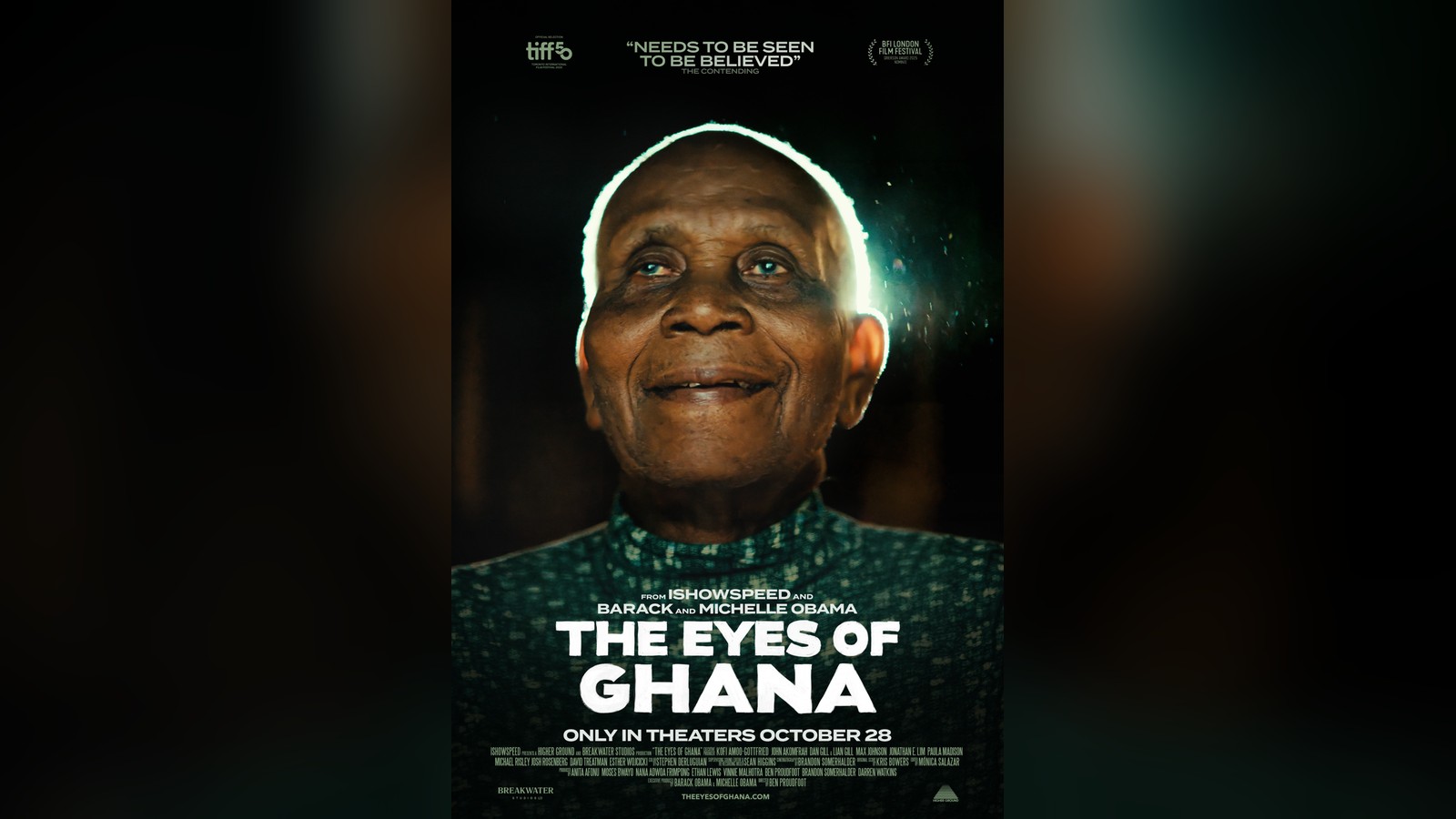
A love letter to cinema that understands why film matters: because somebody has to be there, holding the camera, when history happens.
Movie at a Glance
- US release: Wednesday 28 October 2026, a one-night-only event in selected US and Canadian cinemas
- UK release: Selected UK cinemas from Wednesday 28 October 2026
- Director: Ben Proudfoot
- Featuring: Chris Hesse, Anita Afonu and Edmund Addo
- Producers: Ben Proudfoot, Nana Adwoa Frimpong, Anita Afonu, Moses Bwayo, Brandon Somerhalder and Darren Watkins Jr (IShowSpeed); executive producers include Barack and Michelle Obama
- Music: Kris Bowers
- Runtime: 90 minutes
- Certificate: PG (UK)
- Genre: Documentary
Viewer Match
- Best for: Film lovers, history fans, and anyone moved by Cinema Paradiso or stories about archives saved against the odds.
- Maybe skip if: You want a hard-edged political history of Kwame Nkrumah’s rule, warts and all.
- Mood and pace: Warm, gentle and uplifting, with a big, swelling finale.
- Cinema or streaming? Cinema. This is a film about the communal power of a big screen, and it plays best with a crowd.
- Spoiler level: Spoiler-free. We only describe the set-up.
The Man Behind the Camera
In the 1950s and 1960s Hesse was the personal cameraman to Kwame Nkrumah, the man who led Ghana to independence and dreamed of a united Africa. He was there for the speeches, the summits and the world tours. When Nkrumah was overthrown in 1966, the new regime set about destroying the filmed record of his years in power. Hesse quietly made sure more than a thousand reels survived, stored far away in London.
Now his eyesight is failing, and the race is on to digitise the archive and bring it home. Proudfoot, who won Oscars for the short films The Queen of Basketball and The Last Repair Shop, has a gift for finding unsung people and letting them shine. Hesse is sharp, funny and impossibly spry, and his memory for detail is astonishing. Whenever he talks about the moment a shot was taken, the film comes fully alive.
Passing the Torch
The documentary is really a story about inheritance. Filmmaker Anita Afonu, who first persuaded Hesse that his reels could be saved digitally, becomes his partner in the project, and their friendship is the film’s warm centre. There is mutual respect and plenty of teasing, and when Hesse lectures a room of young Ghanaian filmmakers, you can feel knowledge being handed on in real time.
A second strand follows Edmund Addo, caretaker of The Rex, a once-grand open-air cinema in Accra that has fallen into disrepair. His stubborn devotion to the building gives the film its most touching image: a man guarding an empty screen, waiting for the audience to come back. Proudfoot ties the two stories together neatly, and the payoff, as Hesse’s restored images head towards a public screening, is genuinely stirring.
Beautiful, If Too Polite
The restored footage is extraordinary, rich in colour and alive with faces, though only around 15 minutes of it appears on screen, which leaves you hungry for more. Kris Bowers’ orchestral score, recorded with the Chineke! Orchestra and Ghanaian musicians, is lush and triumphant. Sometimes it is too much, swelling to tell you what to feel in moments that would have landed more powerfully in silence.
The bigger weakness is the film’s reluctance to complicate its hero’s hero. Nkrumah was a visionary, but his later years in power were increasingly authoritarian, and the documentary touches on this only lightly. Hesse’s own long career after the coup is also skipped over. This is a celebration rather than an investigation, and anyone hoping for a full reckoning with Ghana’s turbulent post-independence history will need to look elsewhere.
Why It Matters Now
Still, it is hard to resist a film this generous. At heart, The Eyes of Ghana is about who gets to tell a nation’s story, and why images held in foreign vaults should come home. With IShowSpeed bringing a huge young audience to it, it may reach exactly the people Hesse has spent his life waiting for. For more new releases on the big screen, see our latest Weekly Cinema Pack, and for tonight’s TV and streaming picks, try What to Watch Tonight.
Spoiler-Free Verdict
The Eyes of Ghana is a joyful, deeply affectionate portrait of a remarkable man and the archive he saved. It is conventional and sometimes too reverent, but Chris Hesse is unforgettable, and the restored images are a gift.
- Performances: 8/10
- Direction: 8/10
- Screenplay: 7/10
- Score: 7.5/10
- Cinematography: 8.5/10
- Entertainment Value: 8/10
- Overall score: 8/10
Star rating: 4/5
Verdict badge: Worth Seeing
One-line verdict: A warm, stirring rescue story that makes you fall in love with cinema all over again.
Watch the Official Trailer
Meet Chris Hesse and his hidden archive in the official trailer.
Which moment in history would you most want to see rescued on film? Share your spoiler-free thoughts on The Eyes of Ghana.