
SPOILER WARNING: This Super Review discusses every major turn in all eight episodes of The Gentlemen Season 2, including deaths, betrayals and the finale. If you have not finished the season, pour yourself a whisky, close this page and come back bloodied later.
A good suit can disguise a great many sins. In Season 2 of The Gentlemen, Eddie Horniman’s tailoring remains impeccable; his conscience, less so. Guy Ritchie’s return to Halstead is bigger, blacker and markedly nastier than its first run. Season 2 is a must watch marathon built from immaculate manners, bad decisions and the unnerving realisation that the quietest man in the room may already have decided who is going in the van.
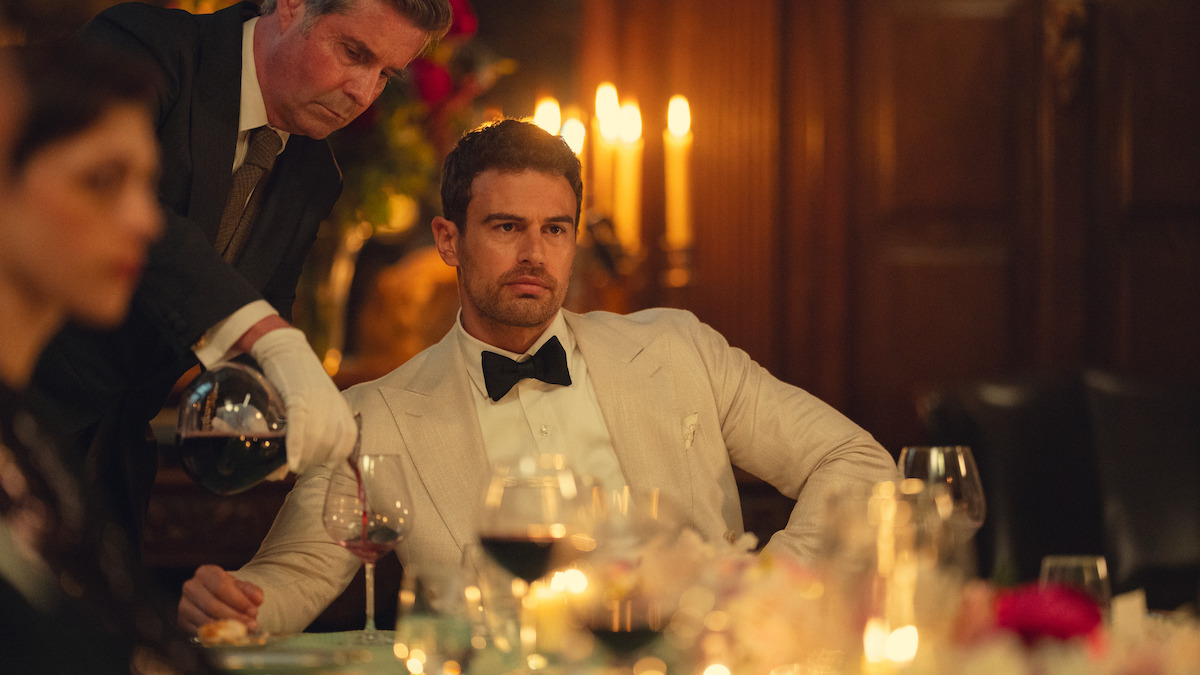
The gentleman has not fallen from grace; he has tailored grace into an alibi.
TV Show at a Glance
- Streaming: Netflix
- Episodes: Eight
- Creator: Guy Ritchie
- Principal cast: Theo James, Kaya Scodelario, Daniel Ings, Ray Winstone, Vinnie Jones and Giancarlo Esposito
- Content advice: Strong violence, gore, threats, drug crime and very coarse language
- Spoiler level: Total. The ending is discussed in full.
Viewer Match
- Best for: Fans of criminal capers with teeth, power games and gorgeous locations.
- Maybe skip if: A chainsaw, a shallow grave and emotional cruelty are not your idea of comfort viewing.
- Mood and pace: Champagne fizz over a trapdoor: brisk, funny, then suddenly it is brutal..
- Streaming verdict: Clear the evening. This is an eight-episode worthy binge with real momentum.
Episode 1 — The Road to Kingdom: ambition arrives in a three-piece suit
The opener cleverly begins with its punchline: Eddie battered, filthy and dragging himself through the countryside. Then it winds back three months to show the Duke feeling wonderfully invincible. Theo James plays the new Eddie not as a man seduced by crime but as a man who has finally admitted he enjoys being good at it. The shooting-party business, the push for a peerage and the Italian overture turn Halstead into a boardroom with shotguns. A tiger, a sheikh and a greedy Lord make for very Ritchie scenery. However, the real hook is Eddie’s appetite. He wants the land back. He wants the Lords. He wants the kingdom.
Episode 2 — There’s a Rat in the Kitchen: Milan adds glamour, rot and a new family problem
The Italian mafia deal makes the season feel properly expanded rather than merely inflated. Eddie and Susie negotiate their way through Milan, whilst Jack Glass attempts a high-stakes night of his own, and the story lets every promise arrive with a concealed invoice. Cico and Bella bring both charm and volatility to the operation; Susie, as ever, can read a room before its occupants know they are lying. The episode is deliciously alert to the fact that an empire does not become international by adding a few boats and sunglasses. It becomes international by importing enemies.
Episode 3 — Do You Reject Satan?: the season’s moral thesis, delivered at a christening
This is where Season 2 earns its darkness. Eddie and Susie arrange a brutally efficient recovery operation, while Eddie stands at Tarquin’s christening and solemnly rejects Satan. The joke is not simply that he has just ordered violence; it is that he seems to hear the hypocrisy and carries on anyway. Geoff becoming Tarquin’s godfather gives Vinnie Jones a beautiful, tender counterweight, and the church setting turns the episode into a blackly comic confession booth. Eddie has stopped pretending the criminal world is temporary. His problem now is that he still wants to think of himself as a decent man inside it.
Episode 4 — The Bigger Picture: Eddie mistakes a clever scheme for freedom
Politics becomes the new battlefield. Eddie spies salvation in cannabis decriminalisation: legal money, legitimate frontage, a way to turn the Glass model into something vast and respectable. Bobby sees only a threat to the system that made him. The strength of this middle chapter is how calmly it stages an argument about business before revealing it is really an argument about ownership. Eddie does not merely want a bigger cut. He wants to write the rules. Susie sees the opportunity and the danger at the same time, while Bobby’s mysticism and paranoia make every conversation feel like it might end in a prophecy or a beating.
Episode 5 — A Suburban A-Road on the Outskirts of Basingstoke: the bill comes due
The flash-forward pays off with merciless economy. Lord Hawthorne’s fatal fall collapses Eddie’s political play, Bobby calls betrayal what Eddie has been calling strategy, and the Duke is beaten, buried and left to claw himself back into the world. It is a superb reset because it strips him of the controlled cool that has become his armour. James is excellent here: cracked open, furious and humiliated, but not purified. Meanwhile Susie is already moving pieces beyond Bobby’s reach. The episode turns a ditch by an A-road into a rebirth scene, only the thing being born is far less human than the man who went in.
Episode 6 — The Bells of San Domenico: love briefly looks like an exit
Italy gives the season its warmest images and its cruellest illusion. Bella proves that she is more than a useful alliance: she can meet Eddie in the space between old money and organised crime, and the marriage begins to feel emotionally real rather than strategically convenient. That is precisely why it hurts. Eddie proposes after surviving Bobby’s punishment, believing Bella travelled every inch of that nightmare with him; after the wedding, her seaplane explodes before his eyes. The series does not make grief tasteful. It makes it abrupt, public and obscene. In one blast, the future Eddie might have chosen disappears.
Episode 7 — This Mad Circus: Geoff takes centre stage and refuses to miss
A home invasion at Halstead threatens Tarquin, and the season sensibly steps aside to let Geoff become the legend the show has been quietly promising. Jones has played him with such reserve that his eruption carries genuine weight: this is not an action-star victory lap but a grandfather defending the only thing that matters. The raid also keeps the season off balance after Bella’s death. Eddie wants revenge; the show gives us a siege. Geoff gives us the answer to what loyalty looks like when it has a rifle.
Episode 8 — Bring Me the Head: the Duke chooses the van
The finale is magnificent, ugly and wonderfully decisive. Eddie tortures the surviving mercenary until he gets the answer he wants—Bobby ordered the attack—then races to reverse the prison hit when Uncle Stan reveals the truth about Eddie’s debt. Bobby survives, Gospel John is exposed, and the betrayal tightens around the person who has been in the frame since the beginning: Freddy. Gospel John weaponised Freddy’s resentment over the inheritance, and Freddy knew enough to become complicit in the attack that killed Bella and endangered the family.
Eddie could shoot Freddy. Instead, he makes him sit in a van with Gospel John and a chainsaw. When Freddy emerges drenched in blood, holding Gospel John’s severed head, Eddie lights a cigar and calls him a good boy. It is a staggeringly bleak final image because the spectacle is not the head; it is Eddie’s method. He has turned revenge into therapy, punishment into family management and horror into a lesson. Season 1’s reluctant Duke would not recognise this man. Season 2 knows that, and refuses to look away.
The performances: everyone understands the assignment, then sharpens it
James gives Eddie a persuasive and disturbing evolution. He never abandons the character’s wit or poise, which makes each new capacity for cruelty land harder. Scodelario remains the season’s most reliable strategic mind; Susie is not reduced to a jealous complication by Bella’s arrival, and her quiet new connection to Carlos Vargas gives her a future that is entirely her own. Daniel Ings takes Freddy from comic grenade to wounded accomplice without losing the character’s absurdity. Jones, meanwhile, supplies the season’s heart and its most ferocious action beat. Ray Winstone’s Bobby is still a magnificent threat, particularly when the bathhouse mysticism turns from amusing eccentricity into a texture of menace.
Style, sound and the cost of getting everything you want
Ritchie and the directing team make the English estate, Milan and Lake Maggiore feel like connected chambers in one very expensive trap. The editing knows when to let a look curdle and when to cut to the violence before the audience can prepare for it. The score and sound design keep the comedy from becoming weightless: a joke may land, then a gunshot or a chainsaw revs and the air changes. There are a few moments where the sprawling business architecture asks the viewer to keep pace, but the season earns that density by making every deal an emotional test. It is about class, certainly, but more sharply about the story people tell themselves when power begins to feel like their birthright.
Verdict Summary
- Performances: 9/10
- Direction: 9/10
- Screenplay: 9/10
- Score: 8.5/10
- Cinematography: 9/10
- Entertainment Value: 10/10
- Overall: 9/10
Badge: Must Watch
Final verdict: The best series I have seen all year: funnier, crueler and more dramatically assured than its already strong first season.
Season 2 makes Eddie’s rise thrilling precisely because it understands what he loses on the way up. It is eight episodes of cultivated chaos with a wicked sense of consequence.
Watch the Official Trailer
Netflix’s official trailer captures the season’s expanded scale and increasingly dangerous ambition.
Have you finished the season? Keep it civil, keep it spoiler-marked, and tell us whether Eddie’s final choice made him a king, a monster, or both.