
A snowbound house, an unfinished body of work and a woman who may be communicating more clearly through silence than anyone around her realises: the official Verity trailer turns the act of reading into an invasion. Every page Lowen Ashleigh opens seems to draw her deeper into a marriage, a mystery and a version of the truth designed to resist certainty.
Trailer at a Glance
- Film: Verity
- Trailer analysed: Official Amazon MGM Studios trailer, released 11 August 2026
- Trailer length: 2 minutes 30 seconds
- UK and worldwide cinema release: 2 October 2026
- Director: Michael Showalter
- Screenplay: Nick Antosca
- Based on the novel by: Colleen Hoover
- Principal cast: Anne Hathaway, Dakota Johnson, Josh Hartnett, Ismael Cruz Córdova and Brady Wagner
Watch the Official Trailer
What the Trailer Reveals
The trailer establishes Lowen Ashleigh as a struggling writer invited into the remote Crawford estate to continue the bestselling series left unfinished after Verity Crawford’s incapacitating accident. Jeremy Crawford brings Lowen into the household, but the footage quickly makes it clear that this is more than a professional assignment. Verity is physically constrained yet visually dominant, repeatedly framed in close-up as if she is studying the room—and Lowen—more intently than anyone suspects.
Lowen begins with the practical debris of another writer’s process: note cards spread across the floor, files on a computer, handwritten pages and boxes of material. The decisive discovery is an autobiographical document hidden among Verity’s work. The trailer presents that manuscript not merely as evidence but as a contaminating voice, blurring what Lowen reads, what she imagines and what may be happening inside the house.
The relationship triangle is equally explicit. Lowen and Jeremy move from guarded conversations towards physical attraction while Verity remains an unnerving presence nearby. The trailer cuts between intimacy, suspicion and sharply fragmented flashes of domestic danger. A child’s unsettling behaviour, a figure moving through dark rooms and Verity’s fixed gaze all suggest that the Crawford family history is far more unstable than the polished estate initially appears.
What the footage refuses to settle is just as important. It does not confirm that the autobiographical pages are truthful, that Lowen’s perceptions are reliable or that Verity’s apparent helplessness tells the whole story. Each apparent revelation creates another possible act of manipulation.
Mood, Craft and Clues
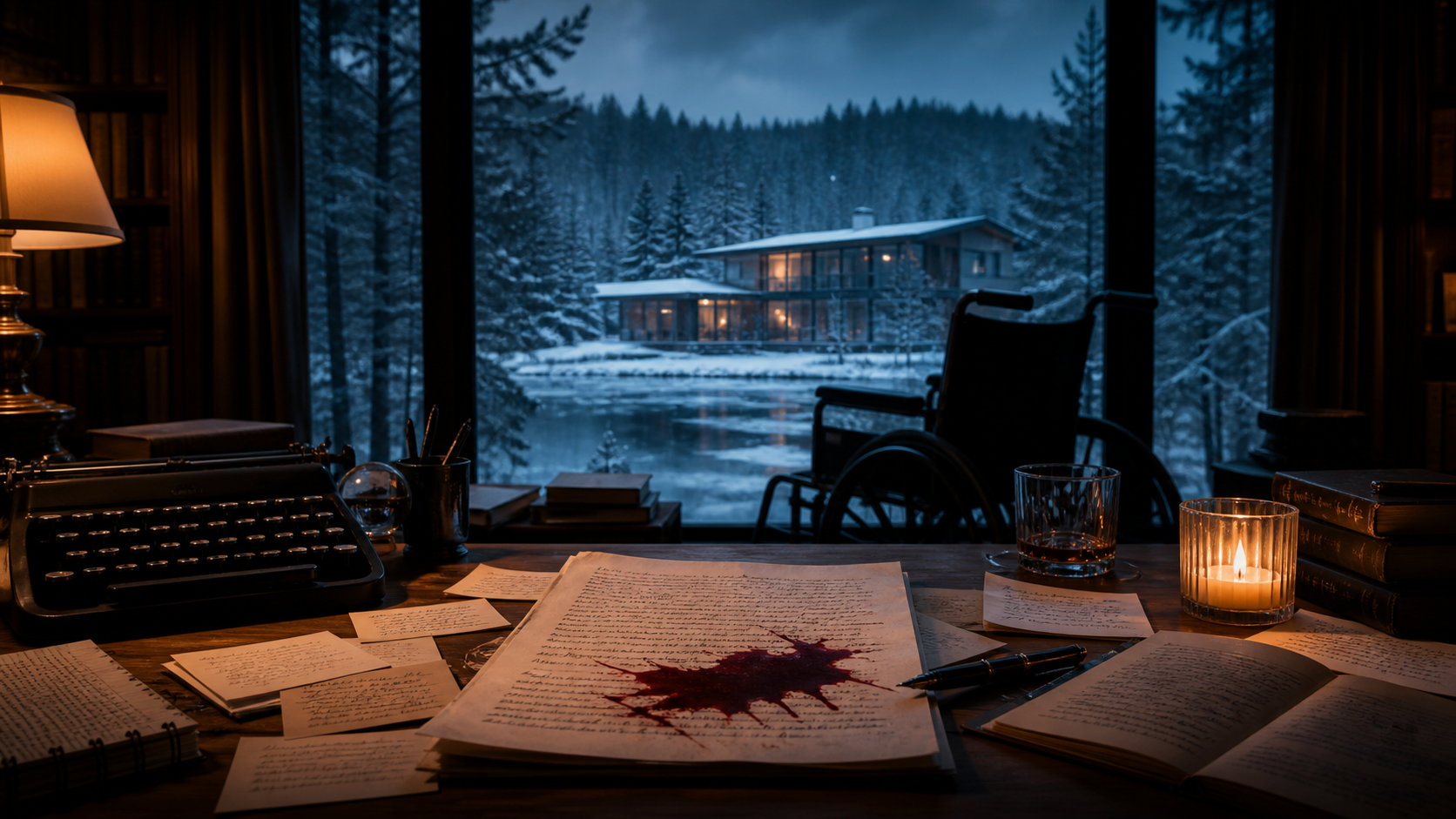
Michael Showalter and the trailer editors build the first half around controlled observation. The Crawford home is expansive but emotionally airless: glass walls expose the winter landscape while timber, shadow and long sightlines turn every room into a place where someone might be watching. The snow outside creates a clean visual field, but inside the house the frames become crowded with papers, reflections and partially obscured faces.
The colour design maps the shift from professional curiosity to psychological entrapment. Early daylight is cold and pale, allowing the estate to resemble an exclusive creative retreat. As Lowen reads further, the palette darkens into teal, amber and hard red accents. Verity’s vivid red clothing becomes a deliberate interruption within the subdued interiors, making her look both vulnerable and dangerously in command of the image.
Writing itself supplies the trailer’s strongest visual language. A typewriter, manuscript pages, index cards and the computer file labelled “Autobiography” turn authorship into a series of clues. The recurring question is not simply what happened, but who gets to frame what happened. Lowen is hired to inhabit Verity’s fictional voice; the hidden document tempts her to accept another voice as confession. The trailer’s editing then makes the audience experience the same uncertainty by offering flashes that could be memory, reconstruction, fantasy or warning.
Anne Hathaway’s stillness is used as a counterweight to Dakota Johnson’s increasingly unsettled reactions. Josh Hartnett’s Jeremy occupies the space between them, presented as grieving husband, employer and object of attraction without allowing any one role to feel entirely secure. The result is a trailer less interested in a single jump scare than in the possibility that every intimate gesture carries a second meaning.
Spoiler-Free Trailer Verdict
Verity sells its mystery through atmosphere rather than explanation. The snowbound estate is immediately memorable, the manuscript device gives the trailer a strong investigative spine and Anne Hathaway’s controlled presence keeps every scene unstable. Its most promising quality is the refusal to identify one reliable perspective: attraction, authorship and alleged confession all become tools that could reveal the truth—or manufacture it.
Which element makes you most suspicious: Verity’s silence, Jeremy’s invitation or the autobiography Lowen discovers?