
Captain’s log, supplemental. I have inspected all ten missions of the Enterprise under Christopher Pike, and I am pleased to report that the ship is still in one piece. Mostly. The crew’s dignity survives too. Partly. Star Trek: Strange New Worlds Season 4 is a spirited, sometimes unruly voyage that remembers the oldest command lesson in the book: when the universe becomes impossible, give the problem to a first-rate crew and keep the engines warm.
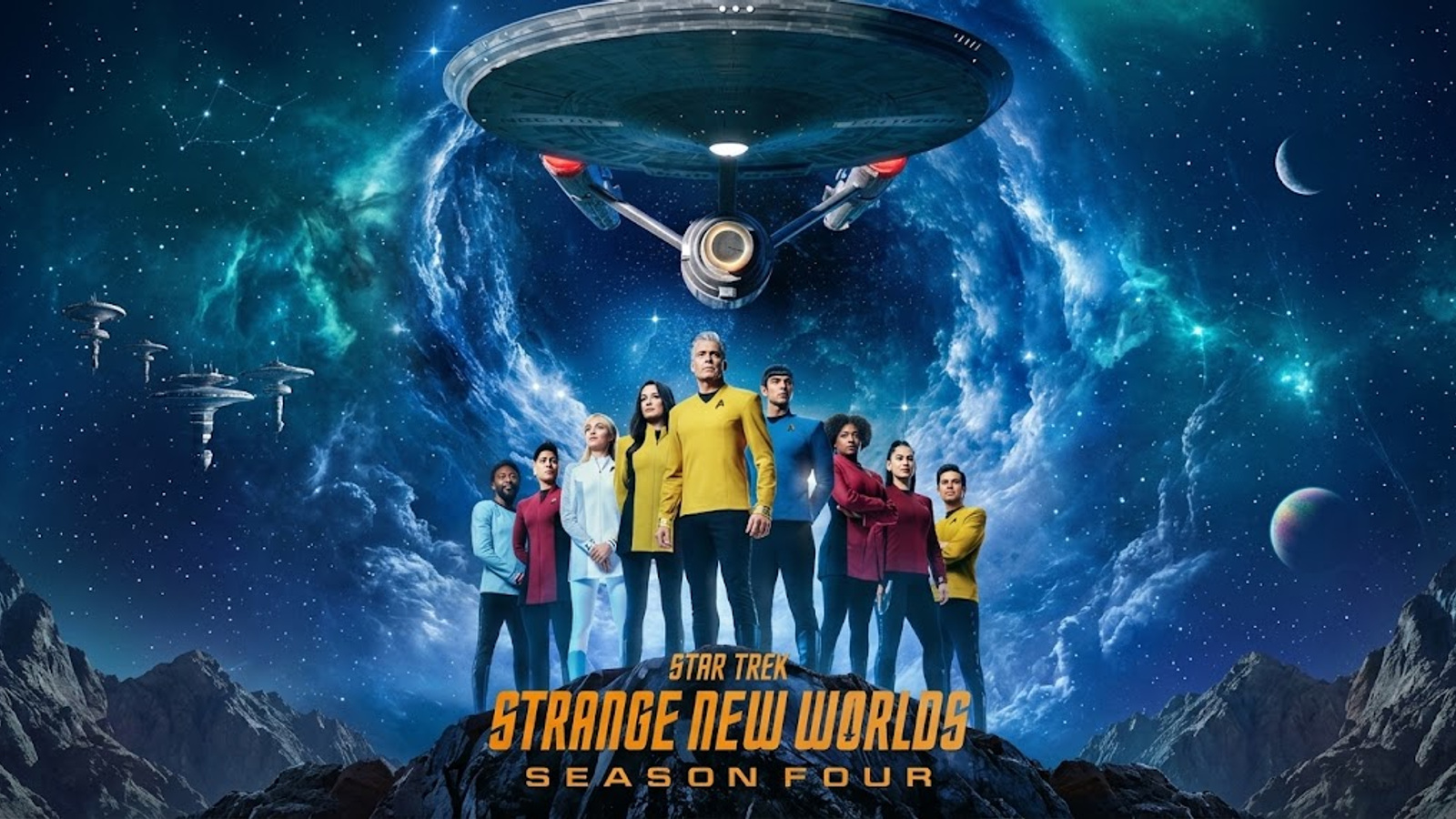
Season four does not merely seek out strange new worlds; it beams comedy, horror, romance, puppetry and command-room tension onto the same bridge—and somehow keeps a recognisable Starfleet heading.
TV Show at a Glance
- Streaming: All ten episodes are available on Paramount+.
- Season run: 23 July–24 September 2026.
- Episodes: Ten, generally running about 46–64 minutes.
- Format: Live-action science-fiction adventure; mostly episodic with continuing character arcs.
- Co-showrunners: Akiva Goldsman and Henry Alonso Myers.
- Principal cast: Anson Mount, Rebecca Romijn, Ethan Peck, Jess Bush, Christina Chong, Celia Rose Gooding, Melissa Navia, Babs Olusanmokun, Martin Quinn and Paul Wesley.
- Content advice: Science-fiction violence, threat, emotional distress and occasional horror; episode classifications vary.
- Spoiler level: Spoiler-free. Premises and tone are discussed, but outcomes are not.
Viewer Match
- Best for: Viewers who like classic mission-of-the-week Trek, warm ensemble chemistry and a franchise willing to experiment.
- Maybe skip if: You want one uniform tone; this season can jump from existential peril to heightened comedy faster than a transporter malfunction.
- Mood and pace: Buoyant, adventurous and emotionally sincere, with ten sharply different missions.
- Streaming verdict: Watch over several evenings. Warp-speed bingeing blurs the flavours that make each episode distinctive.
Captain Pike’s Enterprise Still Knows Its Mission
Anson Mount remains the gravitational centre of the series, but Pike’s great strength is knowing when command means stepping back. Season four repeatedly gives the bridge to somebody else: Una wrestles with responsibility, Spock tries to force logic around gloriously illogical circumstances, La’an meets emotional problems no phaser can solve, and Uhura continues becoming the officer history already promised she would be. The result feels less like a star vehicle and more like a functioning starship. Every console matters.
That ensemble spirit is the season’s chief defence against tonal whiplash. One mission may brush against horror, another turns the laws of reality into a cosmic joke, and another examines duty with the severity of a Starfleet tribunal. Yet the crew’s affection keeps the decks connected. Rebecca Romijn gives Una steel without sacrificing warmth; Ethan Peck finds new comic timing inside Spock’s precision; Christina Chong makes La’an’s guardedness feel active rather than remote; and Celia Rose Gooding brings Uhura the alert intelligence of someone already hearing signals the rest of the room has missed.
Ten Missions, No Safe Setting on the Universal Translator
“Valles Marineris” opens the season with scale and intent, a statement that the Enterprise has not returned for a ceremonial lap. “The Griffin Incident” tightens the screws, leaning into mystery and the anxiety of making decisions before the sensors have supplied a comforting answer. Together they establish a season interested in command as action: not sitting in the chair, but accepting that every order travels through people.
“Human Best Friend” lets the show’s humane instincts off the leash, while “A Case of Chiaroscuro” plays with light, shadow and the unreliable space between them. Then comes “Level-Five Transporter Accident”, the season’s most visible swing: Jim Henson’s Creature Shop built custom puppets for the episode. It is not a throwaway novelty. The practical craft gives the comedy texture, and the cast commits with the seriousness Star Trek has always needed when confronting an absurd premise. Ask anyone who has survived Tribbles: dignity is optional; conviction is not.
“Off-Hour” finds drama in what happens beyond formal duty, an essential idea for a series whose crew can otherwise seem permanently stationed beneath flattering bridge lights. “Like Chronitons Through the Hourglass” announces temporal trouble before the first scan is complete, and it has fun with the franchise’s long tradition of treating time as both scientific frontier and personal ambush. “Orders of Magnitude” returns the focus to scale, consequence and the unnerving distance between a clean order and its messy result.
“Once La’an a Time” puts its character clue directly in the title and gives Chong welcome room to navigate the collision between armour and feeling. Finally, “Tomorrow’s Enterprise” enters carrying a title calculated to make veteran fans sit upright. It does not need to imitate The Next Generation classic “Yesterday’s Enterprise” to activate that history. The echo is the point: Star Trek knows tomorrow is built by the choice made at the worst possible moment. The finale understands the weight of inheritance while keeping Pike’s ship responsible for its own destiny.
Genre-Hopping at Warp Factor Nine
Co-showrunners Akiva Goldsman and Henry Alonso Myers continue treating the episodic format as a licence to change the rules. That can be exhilarating. Many streaming series use eight or ten hours to stretch one film-sized idea; Strange New Worlds prefers to open a new hatch every week. Season four can be a command drama, creature feature, relationship story, temporal puzzle and handmade puppet show without filing a change-of-course report.
The price is inconsistency. A few transitions feel as though the helm has jumped from impulse power to maximum warp, and not every comic flourish lands with equal precision. Viewers who favour the stricter moral machinery of “The Menagerie” era may occasionally wonder who left the holodeck safety protocols off. Still, ambition is a better problem than timidity. Even the wobblier missions are made by people curious about what Star Trek can contain, not merely what its iconography can sell.
The Bridge Crew Is the Special Effect
The production remains handsome: clean starship geometry, expressive colour, tactile costumes and digital vistas that give the Enterprise somewhere grand to fly. Yet the season’s most persuasive effect is a cast able to pivot together. Jess Bush gives Chapel velocity and vulnerability; Melissa Navia makes Ortegas’s confidence feel lived-in rather than decorative; Babs Olusanmokun continues to suggest whole medical and spiritual histories behind M’Benga’s quiet gaze; Martin Quinn brings Scotty the dangerous sparkle of an engineer who has already decided the manual is more of a suggestion.
Paul Wesley’s James T. Kirk remains wisely positioned as part of this era rather than its owner. He has the appetite for risk, certainly, but the performance also shows the officer still learning the difference between instinct and command. As a future captain might put it: courage without judgement is simply a faster route to the casualty list. His scenes with Spock carry the pleasure of destiny approaching without turning every exchange into a museum exhibit.
Sound, Score and the Music of a Working Starship
The score knows when to salute the franchise and when to chart its own course. Familiar musical shapes arrive like a distant subspace signal rather than a demand for applause. Sound design does similarly precise work: bridge systems hum beneath dialogue, transporters retain their little miracle of danger, and action sequences give phasers and machinery weight without drowning the human decision at their centre.
Visually, the series still loves faces as much as nebulae. Directors use the bridge as a pressure chamber, letting a pause between an order and its execution tell us who trusts whom. The widescreen spectacle is welcome, but close-ups win the season. Star Trek has always been a universe where one raised eyebrow can outperform an armada.
Where the Course Wobbles
Season four’s weakness is not a lack of ideas; it is traffic control. Ten episodes carry enough genre, romance, mythology and legacy material for a much longer voyage. Some emotional turns would benefit from one more quiet scene before the red alert sounds, while a handful of callbacks arrive wearing their commemorative badges a little too visibly. The complete season is strongest when continuity enriches character and weaker when recognition becomes the whole joke.
There is also a recurring tension between consequence and reset. Episodic television needs the ship ready for next week, but the best Star Trek episodes leave a small scar on the crew. Season four sometimes explores that scar; elsewhere it admires the wound and moves briskly to the next planet. None of this breaches the hull. It simply keeps an excellent season from becoming an all-timer.
Verdict Summary
- Performances: 9/10
- Direction: 8.5/10
- Screenplay: 8/10
- Score: 8.5/10
- Cinematography: 8.5/10
- Entertainment Value: 9/10
- Overall: 8.5/10
- Star rating: 4.25/5
Badge: Worth Seeing
Final verdict: A confident, big-hearted command performance—occasionally undisciplined, frequently ingenious and unmistakably Star Trek.
Season four boldly accepts that a strange new world can be frightening, funny, handmade or emotionally inconvenient. Its course corrections are sometimes abrupt, but its crew remains irresistible. Set phasers to delighted.
Watch the Official Trailer
Paramount+’s official trailer previews the season’s scale, shifting tones and returning bridge crew without revealing where the final mission lands.
Which Season 4 mission earned a place in your captain’s log—and did “Tomorrow’s Enterprise” leave you ready to boldly go into the final season?